



Quantifying Effect of Geographic Location on Epidemiology of Plasmodium vivax Malaria
Supporting Files
Public Domain

-
-
By Show All

File Language:
English
Details
-
Journal Article:Emerging Infectious Diseases
-
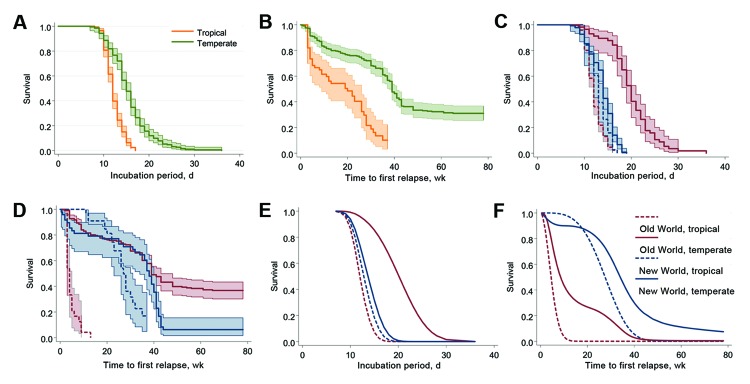
Description:Recent autochthonous transmission of Plasmodium vivax malaria in previously malaria-free temperate regions has generated renewed interest in the epidemiology of this disease. Accurate estimates of the incubation period and time to relapse are required for effective malaria surveillance; however, this information is currently lacking. By using historical data from experimental human infections with diverse P. vivax strains, survival analysis models were used to obtain quantitative estimates of the incubation period and time to first relapse for P. vivax malaria in broad geographic regions. Results show that Eurasian strains from temperate regions have longer incubation periods, and Western Hemisphere strains from tropical and temperate regions have longer times to relapse compared with Eastern Hemisphere strains. The diversity in these estimates of key epidemiologic parameters for P. vivax supports the need for elucidating local epidemiology to inform clinical follow-up and to build an evidence base toward global elimination of malaria.
-
Subjects:
- Research
- Plasmodium vivax
- vivax
- geographic location
- survival analysis
- population surveillance
- epidemiology
- temperate
- tropical
- malaria
- parasites
- vector-borne infections
- Disease-Free Survival
- Female
- Host-Parasite Interactions
- Humans
- Kaplan-Meier Estimate
- Malaria, Vivax
- Male
- Multivariate Analysis
- Recurrence
- Tropical Climate
- Western World
-
ISSN:1080-6059 (online) ; 1080-6040 (print)
-
Publisher:
-
Document Type:
-
Genre:
-
License:
-
Rights:Open Access
-
CIO:
-
Division:
-
Topic:
-
Volume:19
-
Issue:7
-
Download URL:
-
File Type:
 [PDF - 454.93 KB]
-
Collection(s):
-
Main Document Checksum:urn:sha-512:8b4bb6ae7f2a88a4740eeac22f2a0d3771964264f91f0fe1243edaf983c2aa48c248ffae4d34d9d88843dc3bcd38de99b8b29b64b45e0d060472760eb6d88ce0

Supporting Files


File Language:
English
 Was this page helpful?
 Found an issue?




CDC STACKS serves as an archival repository of CDC-published products including
scientific findings, journal articles, guidelines, recommendations, or other public health information authored or
co-authored by CDC or funded partners.
As a repository, CDC STACKS retains documents in their original published format to ensure public access to scientific information.
As a repository, CDC STACKS retains documents in their original published format to ensure public access to scientific information.
You May Also Like
COLLECTION
Emerging Infectious Diseases