



Novel Bat-Borne Hantavirus, Vietnam
Supporting Files
Public Domain

-
2013/07/01
-
Series: Emerging Infectious Diseases
File Language:
English
Details
-
Journal Article:Emerging Infectious Diseases
-
Personal Author:Arai, Satoru ; Nguyen, Son Truong ; Boldgiv, Bazartseren ; Fukui, Dai ; Araki, Kazuko ; Dang, Can Ngoc ; Ohdachi, Satoshi D. ; Nguyen, Nghia Xuan ; Pham, Tien Duc ; Boldbaatar, Bazartseren ; Satoh, Hiroshi ; Yoshikawa, Yasuhiro ; Morikawa, Shigeru ; Tanaka-Taya, Keiko ; Yanagihara, Richard ; Oishi, Kazunori
-
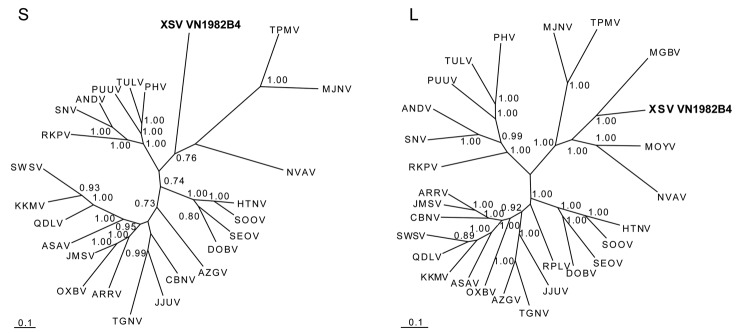
Description:Compelling evidence of genetically distinct hantaviruses (family Bunyaviridae) in multiple species of shrews and moles (order Soricomorpha, families Soricidae and Talpidae) across 4 continents (1–7) suggests that soricomorphs, rather than rodents (order Rodentia, families Muridae and Cricetidae), might be the primordial hosts (6,7). Recently, the host range of hantaviruses has been further expanded by the discovery that insectivorous bats (order Chiroptera) also serve as reservoirs (8,9). Conjecturing that Mouyassué virus in the banana pipistrelle (Neoromicia nanus) in Côte d’Ivoire (8) and Magboi virus (MGBV) in the hairy split-faced bat (Nycteris hispida) in Sierra Leone (9) represent a much broader geographic distribution of bat-borne hantaviruses, we analyzed tissues from bats captured in Mongolia and Vietnam.
-
Subjects:
-
Series:
-
DOI:
-
ISSN:1080-6059 (digital) ; 1080-6040 (print)
-
Pubmed ID:23763849
-
Pubmed Central ID:PMC3713973
-
Document Type:
-
Genre:
-
Place as Subject:
-
Rights:Public Domain
-
Topic:
-
Location:
-
Volume:19
-
Issue:7
-
Citation:Emerg Infect Dis. 19(7):1159-1161.
-
Download URL:
-
File Type:
 [PDF - 330.50 KB]
 -
Collection(s):
-
Main Document Checksum:urn:sha-512:44093ab311529c74cecae76891749be87e2da468870013fa2351d9c3737d8aafb19dca4f0ff51ce53c10ebce6271ec2ac3d19c0b716c5f0007d7129c87e70b11
Supporting Files


File Language:
English
 Was this page helpful?
 Found an issue?

CDC STACKS serves as an archival repository of CDC-published products including
scientific findings, journal articles, guidelines, recommendations, or other public health information authored or
co-authored by CDC or funded partners.
As a repository, CDC STACKS retains documents in their original published format to ensure public access to scientific information.
As a repository, CDC STACKS retains documents in their original published format to ensure public access to scientific information.
You May Also Like
COLLECTION
Emerging Infectious Diseases