


Mycobacterium tuberculosis Specific CD8+ T Cells Rapidly Decline with Antituberculosis Treatment
Supporting Files

-
Dec 04 2013
-
File Language:
English
Details
-
Alternative Title:PLoS One
-
Personal Author:Nyendak, Melissa R. ; Park, Byung ; Null, Megan D. ; Baseke, Joy ; Swarbrick, Gwendolyn ; Mayanja-Kizza, Harriet ; Nsereko, Mary ; Johnson, Denise F. ; Gitta, Phineas ; Okwera, Alphonse ; Goldberg, Stefan ; Bozeman, Lorna ; Johnson, John L. ; Boom, W. Henry ; Lewinsohn, Deborah A. ; Lewinsohn, David M.
-
Corporate Authors:
-
Description:Rationale
Biomarkers associated with response to therapy in tuberculosis could have broad clinical utility. We postulated that the frequency of Mycobacterium tuberculosis (Mtb) specific CD8+ T cells, by virtue of detecting intracellular infection, could be a surrogate marker of response to therapy and would decrease during effective antituberculosis treatment.
Materials and Methods
We performed a prospective cohort study, enrolling between June 2008 and August 2010, of HIV-uninfected Ugandan adults (n = 50) with acid-fast bacillus smear-positive, culture confirmed pulmonary TB at the onset of antituberculosis treatment and the Mtb specific CD4+ and CD8+ T cell responses to ESAT-6 and CFP-10 were measured by IFN-γ ELISPOT at enrollment, week 8 and 24.
Results
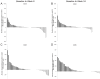
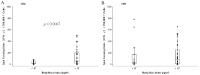
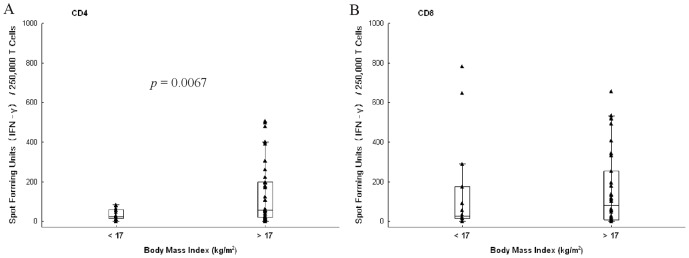
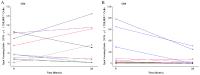
There was a significant difference in the Mtb specific CD8+ T response, but not the CD4+ T cell response, over 24 weeks of antituberculosis treatment (p<0.0001), with an early difference observed at 8 weeks of therapy (p = 0.023). At 24 weeks, the estimated Mtb specific CD8+ T cell response decreased by 58%. In contrast, there was no significant difference in the Mtb specific CD4+ T cell during the treatment. The Mtb specific CD4+ T cell response, but not the CD8+ response, was negatively impacted by the body mass index.
Conclusions
Our data provide evidence that the Mtb specific CD8+ T cell response declines with antituberculosis treatment and could be a surrogate marker of response to therapy. Additional research is needed to determine if the Mtb specific CD8+ T cell response can detect early treatment failure, relapse, or to predict disease progression.
-
Subjects:
-
Source:PLoS One. 2013; 8(12).
-
Document Type:
-
Funding:
-
Volume:8
-
Issue:12
-
Collection(s):
-
Main Document Checksum:urn:sha256:11703a3e529470de337712b0c28caa3446b370fbfea52bf372fb0d887bb6d3db
-
Download URL:
-
File Type:
 [PDF
- 654.25 KB
]
[PDF
- 654.25 KB
]
Supporting Files


File Language:
English
ON THIS PAGE






CDC STACKS serves as an archival repository of CDC-published products including
scientific findings,
journal articles, guidelines, recommendations, or other public health information authored or
co-authored by CDC or funded partners.
As a repository, CDC STACKS retains documents in their original published format to ensure public access to scientific information.
As a repository, CDC STACKS retains documents in their original published format to ensure public access to scientific information.
You May Also Like
COLLECTION
CDC Public Access