


The PROBIT approach in estimating the prevalence of wasting: revisiting bias and precision
Supporting Files
Public Domain

-
Aug 27 2013
Details
-
Alternative Title:Emerg Themes Epidemiol
-
Personal Author:
-
Description:Background
The PROBIT methodology was presented in the 1995 World Health Organization Technical Report on Anthropometry as an alternative to the standard prevalence based method of measuring malnutrition in children. Theoretically the PROBIT method will always give a smaller standard error than the standard prevalence method in measuring malnutrition. A recent article by Dale et al. assessed the PROBIT method for measuring global acute malnutrition measure and found that the method was biased and the precision was superior only for sample sizes less than 150 when compared to the standard method. In a manner similar to Dale, our study further investigated the bias and precision of the PROBIT method for different sample sizes using simulated populations.
Results
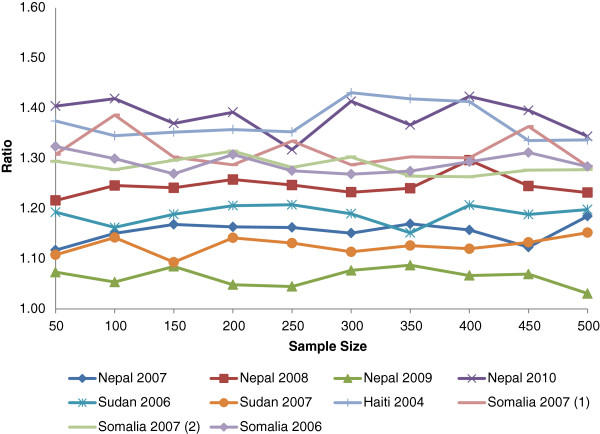
The PROBIT method showed bias for each of the ten simulated populations, but the direction and magnitude of the average bias was changed depending on the simulated population. For a given simulated population, the average bias was relatively constant for all sample sizes drawn. The 95% half-width confidence interval was lower for the PROBIT method than the standard prevalence method regardless of the sample size or simulated population. The absolute difference in the confidence limits showed the most gains for the PROBIT method for the smaller samples sizes, but the ratio of confidence intervals was relatively constant across all sample sizes.
Conclusions
The PROBIT method will provide gains in precision regardless of the sample size, but the method may be biased. The direction and magnitude of the bias depends on the population it is drawn from.
-
Subjects:
-
Source:Emerg Themes Epidemiol. 2013; 10:8.
-
Document Type:
-
Volume:10
-
Collection(s):
-
Main Document Checksum:urn:sha256:346870b74ddcf4f2e37d265a42d2be0e9fd3c1fcdb35aee53870ceb10bc564b4
-
Download URL:
-
File Type:
 [PDF
- 307.57 KB
]
[PDF
- 307.57 KB
]
Supporting Files


ON THIS PAGE


CDC STACKS serves as an archival repository of CDC-published products including
scientific findings,
journal articles, guidelines, recommendations, or other public health information authored or
co-authored by CDC or funded partners.
As a repository, CDC STACKS retains documents in their original published format to ensure public access to scientific information.
As a repository, CDC STACKS retains documents in their original published format to ensure public access to scientific information.
You May Also Like
COLLECTION
CDC Public Access