



Improved Method for the Detection and Quantification of Naegleria fowleri in Water and Sediment Using Immunomagnetic Separation and Real-Time PCR
Supporting Files
Public Domain

-
Oct 21 2013
Details
-
Alternative Title:J Parasitol Res
-
Personal Author:
-
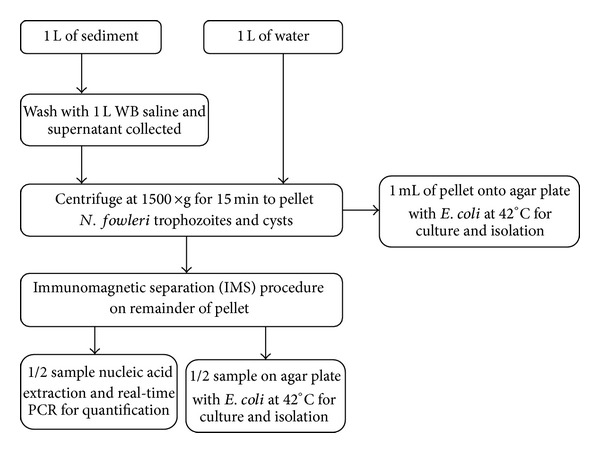
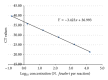
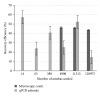
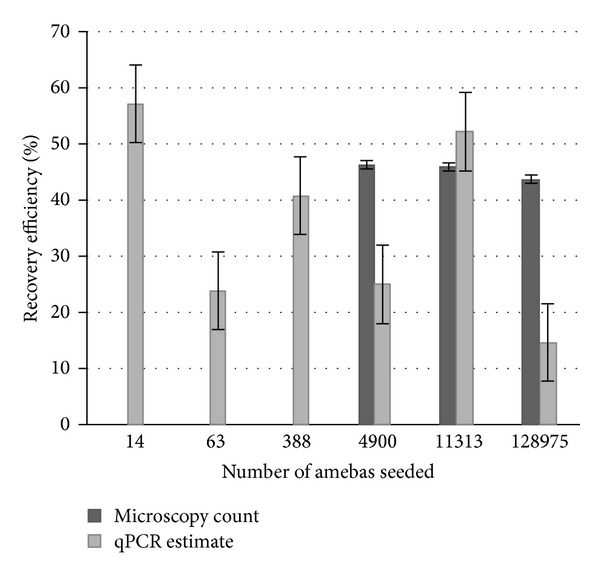
Description:Primary amebic meningoencephalitis (PAM) is a rare and typically fatal infection caused by the thermophilic free-living ameba, Naegleria fowleri. In 2010, the first confirmed case of PAM acquired in Minnesota highlighted the need for improved detection and quantification methods in order to study the changing ecology of N. fowleri and to evaluate potential risk factors for increased exposure. An immunomagnetic separation (IMS) procedure and real-time PCR TaqMan assay were developed to recover and quantify N. fowleri in water and sediment samples. When one liter of lake water was seeded with N. fowleri strain CDC:V212, the method had an average recovery of 46% and detection limit of 14 amebas per liter of water. The method was then applied to sediment and water samples with unknown N. fowleri concentrations, resulting in positive direct detections by real-time PCR in 3 out of 16 samples and confirmation of N. fowleri culture in 6 of 16 samples. This study has resulted in a new method for detection and quantification of N. fowleri in water and sediment that should be a useful tool to facilitate studies of the physical, chemical, and biological factors associated with the presence and dynamics of N. fowleri in environmental systems.
-
Subjects:
-
Source:J Parasitol Res. 2013; 2013.
-
Document Type:
-
Volume:2013
-
Download URL:
-
File Type:
 [PDF - 700.43 KB]
 -
Collection(s):
-
Main Document Checksum:urn:sha256:07c9ca69944bfd8c9612e3b6bc007e9efd5822f9ddfbf902d4bf82aec9032a67
Supporting Files


 Was this page helpful?
 Found an issue?


CDC STACKS serves as an archival repository of CDC-published products including
scientific findings, journal articles, guidelines, recommendations, or other public health information authored or
co-authored by CDC or funded partners.
As a repository, CDC STACKS retains documents in their original published format to ensure public access to scientific information.
As a repository, CDC STACKS retains documents in their original published format to ensure public access to scientific information.
You May Also Like
COLLECTION
CDC Public Access