



Small Food Stores and Availability of Nutritious Foods: A Comparison of Database and In-Store Measures, Northern California, 2009
Supporting Files
Public Domain

-
Jul 12 2012
File Language:
English
Details
-
Journal Article:Preventing Chronic Disease (PCD)
-
Personal Author:
-
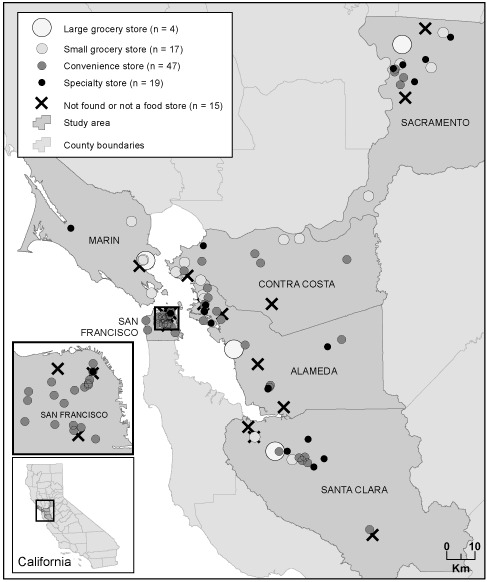
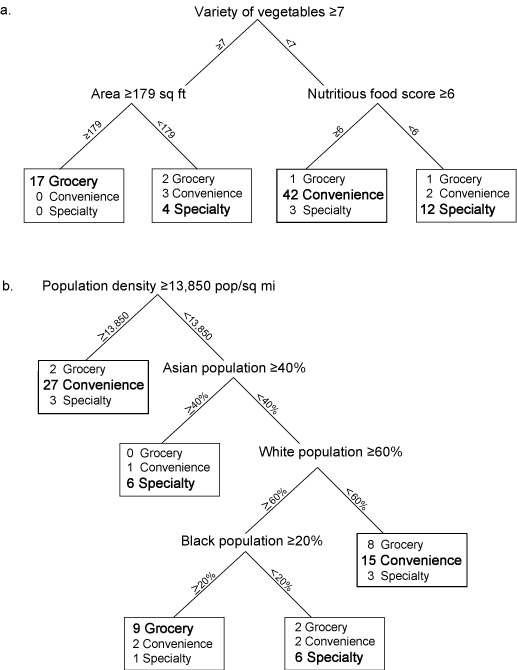
Description:Introduction ; Small food stores are prevalent in urban neighborhoods, but the availability of nutritious food at such stores is not well known. The objective of this study was to determine whether data from 3 sources would yield a single, homogenous, healthful food store category that can be used to accurately characterize community nutrition environments for public health research. ; Methods ; We conducted in-store surveys in 2009 on store type and the availability of nutritious food in a sample of nonchain food stores (n = 102) in 6 predominantly urban counties in Northern California (Alameda, Contra Costa, Marin, Sacramento, San Francisco, and Santa Clara). We compared survey results with commercial database information and neighborhood sociodemographic data by using independent sample t tests and classification and regression trees. ; Results ; Sampled small food stores yielded a heterogeneous group of stores in terms of store type and nutritious food options. Most stores were identified as convenience (54%) or specialty stores (22%); others were small grocery stores (19%) and large grocery stores (5%). Convenience and specialty stores were smaller and carried fewer nutritious and fresh food items. The availability of nutritious food and produce was better in stores in neighborhoods that had a higher percentage of white residents and a lower population density but did not differ significantly by neighborhood income. ; Conclusion ; Commercial databases alone may not adequately categorize small food stores and the availability of nutritious foods. Alternative measures are needed to more accurately inform research and policies that seek to address disparities in diet-related health conditions.
-
Subjects:
-
Source:Prev Chronic Dis. 9.
-
ISSN:1545-1151
-
Document Type:
-
Place as Subject:
-
Location:
-
Volume:9
-
Download URL:
-
File Type:
 [PDF - 296.27 KB]
 -
Collection(s):
-
Main Document Checksum:urn:sha-512:5455318f4ea8ac334bca9e088b442d8eea33f07777a4e8ebd078ca15be5367aab1d7be1223cc248904457c69b6f32d070afd5014c009ca1de94e9300ce078b5a
Supporting Files


File Language:
English
 Was this page helpful?
 Found an issue?


CDC STACKS serves as an archival repository of CDC-published products including
scientific findings, journal articles, guidelines, recommendations, or other public health information authored or
co-authored by CDC or funded partners.
As a repository, CDC STACKS retains documents in their original published format to ensure public access to scientific information.
As a repository, CDC STACKS retains documents in their original published format to ensure public access to scientific information.
You May Also Like
COLLECTION
Preventing Chronic Disease