


Nonprimate Hepaciviruses in Domestic Horses, United Kingdom
Supporting Files
Public Domain

-
Dec 2012
-
File Language:
English
Details
-
Alternative Title:Emerg Infect Dis
-
Personal Author:
-
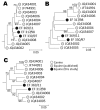
Description:Although the origin of hepatitis C virus infections in humans remains undetermined, a close homolog of this virus, termed canine hepacivirus (CHV) and found in respiratory secretions of dogs, provides evidence for a wider distribution of hepaciviruses in mammals. We determined frequencies of active infection among dogs and other mammals in the United Kingdom. Samples from dogs (46 respiratory, 99 plasma, 45 autopsy samples) were CHV negative by PCR. Screening of 362 samples from cats, horses, donkeys, rodents, and pigs identified 3 (2%) positive samples from 142 horses. These samples were genetically divergent from CHV and nonprimate hepaciviruses that horses were infected with during 2012 in New York state, USA. Investigation of infected horses demonstrated nonprimate hepacivirus persistence, high viral loads in plasma (10(5)-10(7) RNA copies/mL), and liver function test results usually within reference ranges, although several values ranged from high normal to mildly elevated. Disease associations and host range of nonprimate hepaciviruses warrant further investigation.
-
Subjects:
-
Source:Emerg Infect Dis. 18(12):1976-1982.
-
Document Type:
-
Place as Subject:
-
Location:
-
Volume:18
-
Issue:12
-
Collection(s):
-
Main Document Checksum:urn:sha256:7623b0e51a07400a2cf3476ce6f01cca454a08798d3ffba3ffc1bc065d25c563
-
Download URL:
-
File Type:
 [PDF
- 378.60 KB
]
[PDF
- 378.60 KB
]
Supporting Files


File Language:
English
ON THIS PAGE

CDC STACKS serves as an archival repository of CDC-published products including
scientific findings,
journal articles, guidelines, recommendations, or other public health information authored or
co-authored by CDC or funded partners.
As a repository, CDC STACKS retains documents in their original published format to ensure public access to scientific information.
As a repository, CDC STACKS retains documents in their original published format to ensure public access to scientific information.
You May Also Like
COLLECTION
Emerging Infectious Diseases