



Reservoir Competence of Wildlife Host Species for Babesia microti
Supporting Files
Public Domain

-
Dec 2012
File Language:
English
Details
-
Alternative Title:Emerg Infect Dis
-
Personal Author:
-
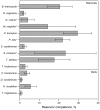
Description:Human babesiosis is an increasing health concern in the northeastern United States, where the causal agent, Babesia microti, is spread through the bite of infected Ixodes scapularis ticks. We sampled 10 mammal and 4 bird species within a vertebrate host community in southeastern New York to quantify reservoir competence (mean percentage of ticks infected by an individual host) using real-time PCR. We found reservoir competence levels >17% in white-footed mice (Peromyscus leucopus), raccoons (Procyon lotor), short-tailed shrews (Blarina brevicauda), and eastern chipmunks (Tamias striatus), and <6% but >0% in all other species, including all 4 bird species. Data on the relative contributions of multiple host species to tick infection with B. microti and level of genetic differentiation between B. microti strains transmitted by different hosts will help advance understanding of the spread of human babesiosis.
-
Subjects:
-
Source:Emerg Infect Dis. 18(12):1951-1957.
-
Document Type:
-
Place as Subject:
-
Location:
-
Volume:18
-
Issue:12
-
Download URL:
-
File Type:
 [PDF - 282.96 KB]
 -
Collection(s):
-
Main Document Checksum:urn:sha256:ab63ccdc54ecdb9c4997571ef23638ae0f4f324b37d208f960c286f4a77c6dc9
Supporting Files


File Language:
English
 Was this page helpful?
 Found an issue?


CDC STACKS serves as an archival repository of CDC-published products including
scientific findings, journal articles, guidelines, recommendations, or other public health information authored or
co-authored by CDC or funded partners.
As a repository, CDC STACKS retains documents in their original published format to ensure public access to scientific information.
As a repository, CDC STACKS retains documents in their original published format to ensure public access to scientific information.
You May Also Like
COLLECTION
Emerging Infectious Diseases