



Risk Factors for Pandemic (H1N1) 2009 Virus Seroconversion among Hospital Staff, Singapore
Supporting Files
Public Domain

-
Oct 2010
File Language:
English
Details
-
Alternative Title:Emerg Infect Dis
-
Personal Author:
-
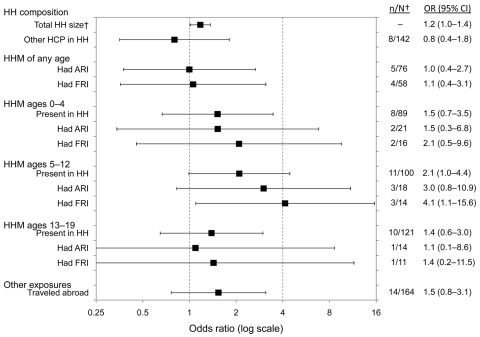
Description:We describe incidence and risk factors for pandemic (H1N1) 2009 virus infection in healthcare personnel during the June-September 2009 epidemic in Singapore. Personnel contributed 3 serologic samples during June-October 2009, with seroconversion defined as a ≥4-fold increase in hemagglutination inhibition titers to pandemic (H1N1) 2009. Of 531 participants, 35 showed evidence of seroconversion. Seroconversion rates were highest in nurses (28/290) and lowest in allied health staff (2/116). Significant risk factors on multivariate analysis were being a nurse (adjusted odds ratio aOR 4.5, 95% confidence interval CI 1.0-19.6) and working in pandemic (H1N1) 2009 isolation wards (aOR 4.5, 95% CI 1.3-15.6). Contact with pandemic (H1N1) 2009-infected colleagues (aOR 2.5, 95% CI 0.9-6.6) and larger household size (aOR 1.2, 95% CI 1.0-1.4) were of borderline significance. Our study suggests that seroconversion was associated with occupational and nonoccupational risk factors.
-
Subjects:
-
Source:Emerg Infect Dis. 16(10):1554-1561.
-
Document Type:
-
Place as Subject:
-
Volume:16
-
Issue:10
-
Download URL:
-
File Type:
 [PDF - 222.11 KB]
 -
Collection(s):
-
Main Document Checksum:urn:sha256:5d5916d940c230d0ba58f62cea1095242d293d8e844b3b2556246bfb4e61ad5d
Supporting Files


File Language:
English
 Was this page helpful?
 Found an issue?

CDC STACKS serves as an archival repository of CDC-published products including
scientific findings, journal articles, guidelines, recommendations, or other public health information authored or
co-authored by CDC or funded partners.
As a repository, CDC STACKS retains documents in their original published format to ensure public access to scientific information.
As a repository, CDC STACKS retains documents in their original published format to ensure public access to scientific information.
You May Also Like
COLLECTION
Emerging Infectious Diseases