



Population Structure of East African Relapsing Fever Borrelia spp.
Supporting Files
Public Domain

-
Jul 2010
Details
-
Alternative Title:Emerg Infect Dis
-
Personal Author:
-
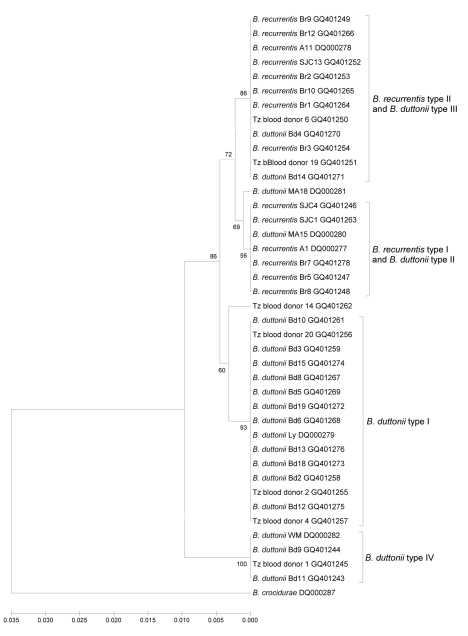
Description:Differentiation of endemic East African tick-borne relapsing fever Borrelia duttonii spirochetes from epidemic louse-borne relapsing fever (LBRF) B. recurrentis spirochetes into different species has been questioned. We assessed a noncoding intragenic spacer (IGS) region to compare genotypes found in clinical samples from relapsing fever patients. Although IGS typing was highly discriminatory and resolved 4 East African tick-borne relapsing fever groups from a disease-endemic region in Tanzania, 2 IGS clades were found among LBRF patients in Ethiopia. The 2 IGS sequence types for B. recurrentis overlapped with 2 of the 4 groups found among B. duttonii. All cultivable isolates of B. duttonii fell into a single IGS cluster, which suggests their analysis might introduce selective bias. We provide further support that B. recurrentis is a subset of B. duttonii and represents an ecotype rather than a species. These observations have disease control implications and suggest LBRF Borrelia spp. could reemerge from its tick-borne reservoirs where vectors coexist.
-
Subjects:
-
Source:Emerg Infect Dis. 16(7):1076-1080.
-
Document Type:
-
Place as Subject:
-
Location:
-
Volume:16
-
Issue:7
-
Download URL:
-
File Type:
 [PDF - 120.33 KB]
 -
Collection(s):
-
Main Document Checksum:urn:sha256:cf03e38284bcf9a73bcd75584577f195409b0230c041ca5de060696c399600a3
Supporting Files


 Was this page helpful?
 Found an issue?

CDC STACKS serves as an archival repository of CDC-published products including
scientific findings, journal articles, guidelines, recommendations, or other public health information authored or
co-authored by CDC or funded partners.
As a repository, CDC STACKS retains documents in their original published format to ensure public access to scientific information.
As a repository, CDC STACKS retains documents in their original published format to ensure public access to scientific information.
You May Also Like
COLLECTION
Emerging Infectious Diseases