



Lack of Airborne Transmission during Outbreak of Pandemic (H1N1) 2009 among Tour Group Members, China, June 2009
Supporting Files
Public Domain

-
Oct 2009
File Language:
English
Details
-
Alternative Title:Emerg Infect Dis
-
Personal Author:Han, Ke ; Zhu, Xiaoping ; He, Fan ; Liu, Lunguang ; Zhang, Lijie ; Ma, Huilai ; Tang, Xinyu ; Huang, Ting ; Zeng, Guang ; Zhu, Bao-Ping
-
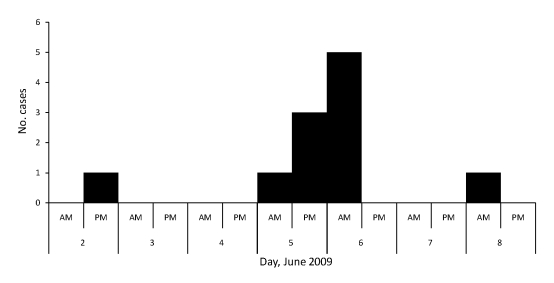
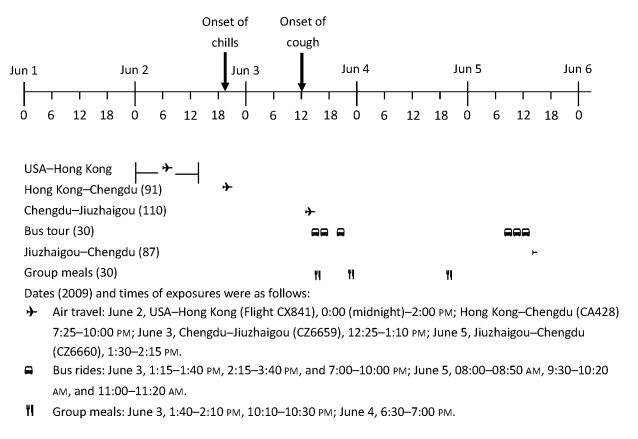
Description:During June 2-8, 2009, an outbreak of influenza A pandemic (H1N1) 2009 occurred among 31 members of a tour group in China. To identify the mode of transmission and risk factors, we conducted a retrospective cohort investigation. The index case-patient was a female tourist from the United States. Secondary cases developed in 9 (30%) tour group members who had talked with the index case-patient and in 1 airline passenger (not a tour group member) who had sat within 2 rows of her. None of the 14 tour group members who had not talked with the index case-patient became ill. This outbreak was apparently caused by droplet transmission during coughing or talking. That airborne transmission was not a factor is supported by lack of secondary cases among fellow bus and air travelers. Our findings highlight the need to prevent transmission by droplets and fomites during a pandemic.
-
Subjects:
-
Source:Emerg Infect Dis. 15(10):1578-1581.
-
Document Type:
-
Place as Subject:
-
Location:
-
Volume:15
-
Issue:10
-
Download URL:
-
File Type:
 [PDF - 471.10 KB]
 -
Collection(s):
-
Main Document Checksum:urn:sha256:2cb26683ca9cc1166aeb16309054c02453edfa5d0d256cfa4851b248045e3891
Supporting Files


File Language:
English
 Was this page helpful?
 Found an issue?


CDC STACKS serves as an archival repository of CDC-published products including
scientific findings, journal articles, guidelines, recommendations, or other public health information authored or
co-authored by CDC or funded partners.
As a repository, CDC STACKS retains documents in their original published format to ensure public access to scientific information.
As a repository, CDC STACKS retains documents in their original published format to ensure public access to scientific information.
You May Also Like
COLLECTION
Emerging Infectious Diseases