



Escherichia albertii in Wild and Domestic Birds
Supporting Files
Public Domain

-
Apr 2010
Details
-
Alternative Title:Emerg Infect Dis
-
Personal Author:
-
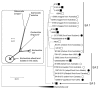
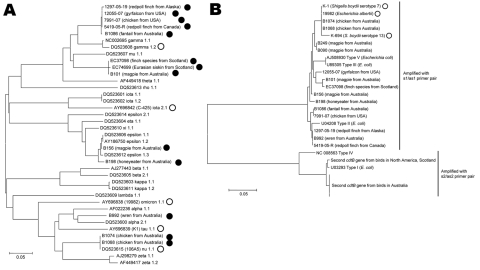
Description:Escherichia albertii has been associated with diarrhea in humans but not with disease or infection in animals. However, in December 2004, E. albertii was found, by biochemical and genetic methods, to be the probable cause of death for redpoll finches (Carduelis flammea) in Alaska. Subsequent investigation found this organism in dead and subclinically infected birds of other species from North America and Australia. Isolates from dead finches in Scotland, previously identified as Escherichia coli O86:K61, also were shown to be E. albertii. Similar to the isolates from humans, E. albertii isolates from birds possessed intimin (eae) and cytolethal distending toxin (cdtB) genes but lacked Shiga toxin (stx) genes. Genetic analysis of eae and cdtB sequences, multilocus sequence typing, and pulsed-field gel electrophoresis patterns showed that the E. albertii strains from birds are heterogeneous but similar to isolates that cause disease in humans.
-
Subjects:
- Research
- Avian
- enteritis
- Escherichia
- pathology
- bacterial toxins
- veterinary
- intimin
- cytolethal distending toxin
- bacteria
- research
- Animals
- Animals, Domestic
- Animals, Wild
- Birds
- Chickens
- Ducks
- Electrophoresis, Gel, Pulsed-Field
- Endotoxins
- Enterobacteriaceae Infections
- Finches
- Geese
- Genes, Bacterial
- Molecular Sequence Data
- Passeriformes
- Polymerase Chain Reaction
- Sequence Analysis, DNA
- Virulence Factors
-
Source:Emerg Infect Dis. 16(4):638-646.
-
Document Type:
-
Volume:16
-
Issue:4
-
Download URL:
-
File Type:
 [PDF - 846.88 KB]
 -
Collection(s):
-
Main Document Checksum:urn:sha256:69700e2355c2bfef681be5b444ab09e6972e9d15c038e3790ea87aaf98a7fe15
Supporting Files


 Was this page helpful?
 Found an issue?





CDC STACKS serves as an archival repository of CDC-published products including
scientific findings, journal articles, guidelines, recommendations, or other public health information authored or
co-authored by CDC or funded partners.
As a repository, CDC STACKS retains documents in their original published format to ensure public access to scientific information.
As a repository, CDC STACKS retains documents in their original published format to ensure public access to scientific information.
You May Also Like
COLLECTION
Emerging Infectious Diseases