



Shiga Toxin–producing Escherichia coli Strains Negative for Locus of Enterocyte Effacement
Supporting Files
Public Domain

-
Mar 2009
Details
-
Alternative Title:Emerg Infect Dis
-
Personal Author:
-
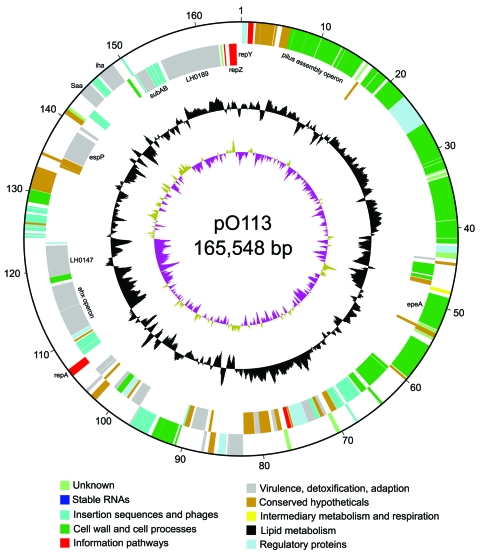
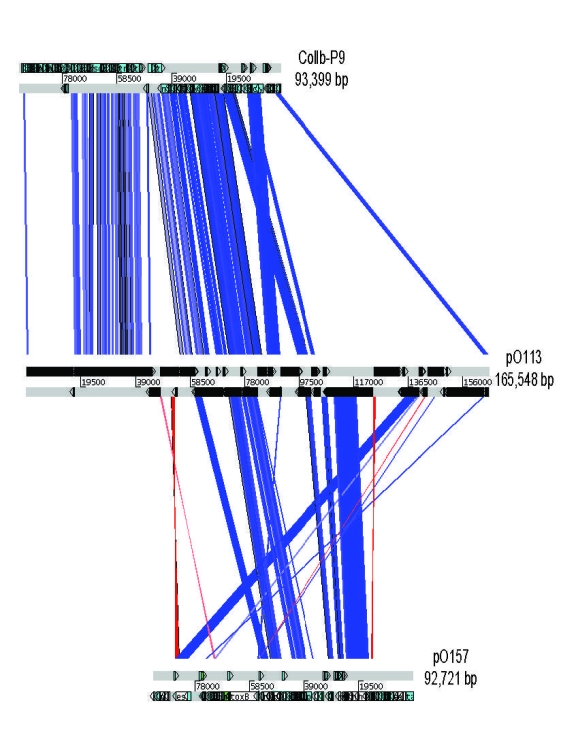
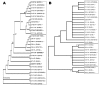
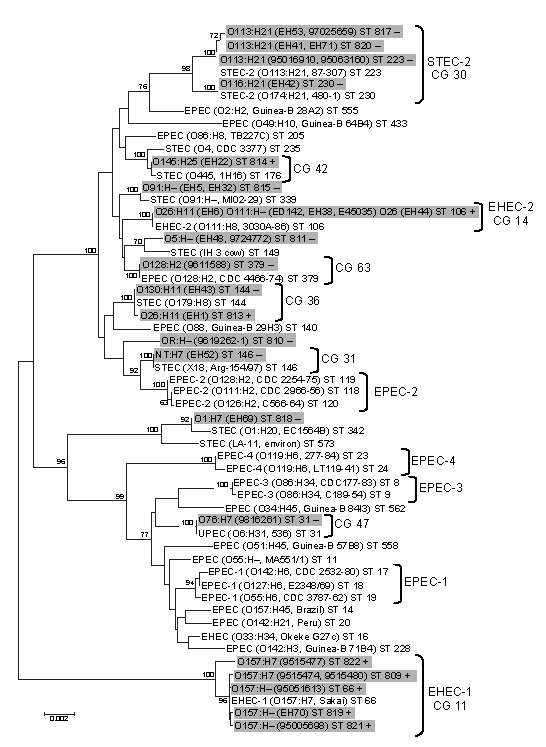
Description:Most Shiga toxin-producing Escherichia coli (STEC) infections that are associated with severe sequelae such as hemolytic uremic syndrome (HUS) are caused by attaching and effacing pathogens that carry the locus of enterocyte effacement (LEE). However, a proportion of STEC isolates that do not carry LEE have been associated with HUS. To clarify the emergence of LEE-negative STEC, we compared the genetic composition of the virulence plasmids pO113 and pO157 from LEE-negative and LEE-positive STEC, respectively. The complete nucleotide sequence of pO113 showed that several plasmid genes were shared by STEC O157:H7. In addition, allelic profiling of the ehxA gene demonstrated that pO113 belongs to a different evolutionary lineage than pO157 and that the virulence plasmids of LEE-negative STEC strains were highly related. In contrast, multilocus sequence typing of 17 LEE-negative STEC isolates showed several clonal groups, suggesting that pathogenic LEE-negative STEC has emerged several times throughout its evolution.
-
Subjects:
- Research
- STEC
- molecular evolution
- EhxA protein
- Escherichia coli plasmids
- foodborne pathogens
- research
- Bacterial Typing Techniques
- DNA Helicases
- Escherichia coli O157
- Escherichia coli Proteins
- Hemolysin Proteins
- Hemolytic-Uremic Syndrome
- Humans
- Phosphoproteins
- Phylogeny
- Plasmids
- Sequence Analysis, DNA
- Shiga-Toxigenic Escherichia coli
- Trans-Activators
- Virulence
-
Source:Emerg Infect Dis. 15(3):372-380.
-
Document Type:
-
Volume:15
-
Issue:3
-
Download URL:
-
File Type:
 [PDF - 316.92 KB]
 -
Collection(s):
-
Main Document Checksum:urn:sha256:fba6a60c07de8a0689ab24f0177f6ef3ce6f49dafe8c8b506e42c6c055a8a02e
Supporting Files


 Was this page helpful?
 Found an issue?




CDC STACKS serves as an archival repository of CDC-published products including
scientific findings, journal articles, guidelines, recommendations, or other public health information authored or
co-authored by CDC or funded partners.
As a repository, CDC STACKS retains documents in their original published format to ensure public access to scientific information.
As a repository, CDC STACKS retains documents in their original published format to ensure public access to scientific information.
You May Also Like
COLLECTION
Emerging Infectious Diseases