



Cross-Border Dissemination of Methicillin-Resistant Staphylococcus aureus, Euregio Meuse-Rhin Region
Supporting Files
Public Domain

-
May 2009
File Language:
English
Details
-
Alternative Title:Emerg Infect Dis
-
Personal Author:Deurenberg, Ruud H. ; Nulens, Eric ; Valvatne, Havard ; Sebastian, Silvie ; Driessen, Christel ; Craeghs, Jos ; De Brauwer, Els ; Heising, Bernhard ; Kraat, Yvette J. ; Riebe, Joachim ; Stals, Frans S. ; Trienekens, Thera A. ; Scheres, Jacques ; Friedrich, Alexander W. ; van Tiel, Frank H. ; Beisser, Patrick S. ; Stobberingh, Ellen E.
-
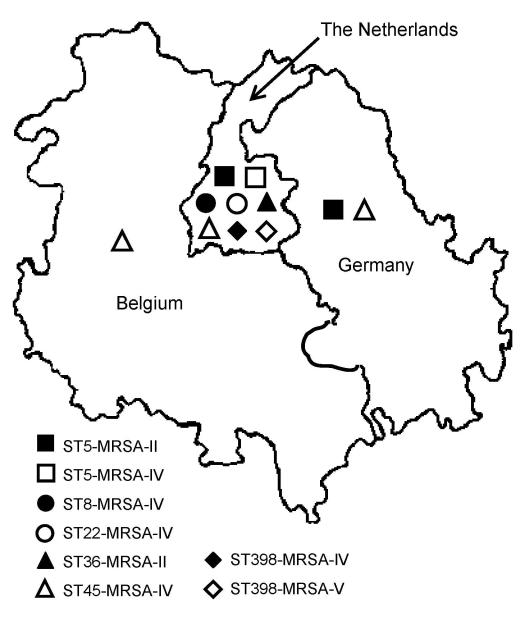
Description:Because the prevalence of methicillin-resistant Staphylococcus aureus (MRSA) differs among the 3 countries forming the Euregio Meuse-Rhin (EMR) region (Belgium, Germany, and the Netherlands), cross-border healthcare requires information about the spread of MRSA in the EMR. We investigated the emergence, dissemination, and diversity of MRSA clones in the EMR by using several typing methods. MRSA associated with clonal complexes 5, 8, 30, and 45 was disseminated throughout the EMR. Dutch isolates, mainly associated with sequence types (ST) ST5-MRSA-II, ST5-MRSA-IV, ST8-MRSA-IV, and ST45-MSRA-IV had a more diverse genetic background than the isolates from Belgium and Germany, associated with ST45-MRSA-IV and ST5-MRSA-II, respectively. MRSA associated with pigs (ST398-MRSA-IV/V) was found in the Dutch area of the EMR. Five percent of the MRSA isolates harbored Panton-Valentine leukocidin and were classified as community-associated MRSA associated with ST1, 8, 30, 80, and 89.
-
Subjects:
-
Source:Emerg Infect Dis. 15(5):727-734.
-
Document Type:
-
Place as Subject:
-
Volume:15
-
Issue:5
-
Download URL:
-
File Type:
 [PDF - 560.28 KB]
 -
Collection(s):
-
Main Document Checksum:urn:sha256:8ff4cc69f037c4647c324c3df72f7c85e60328cfc7ab39604b67375b46c1139c
Supporting Files


File Language:
English
 Was this page helpful?
 Found an issue?

CDC STACKS serves as an archival repository of CDC-published products including
scientific findings, journal articles, guidelines, recommendations, or other public health information authored or
co-authored by CDC or funded partners.
As a repository, CDC STACKS retains documents in their original published format to ensure public access to scientific information.
As a repository, CDC STACKS retains documents in their original published format to ensure public access to scientific information.
You May Also Like
COLLECTION
Emerging Infectious Diseases