



Manhattan Vision Screening and Follow-up Study (NYC-SIGHT): Vision and refractive error results
Supporting Files

-
3 07 2024
-
Available in CDC Stacks on September 07, 2025, 12:00 AM
File Language:
English
Details
-
Alternative Title:Clin Exp Optom
-
Personal Author:
-
Description:Clinical relevance:
Optometrists can play a key role in providing access to eye care in underserved populations by organising community-based eye health screenings that include optometric exams to detect vision impairment and uncorrected refractive error.
Background:
Community-based eye health screenings and optometric exams were conducted in the NYC-SIGHT Study.
Methods:
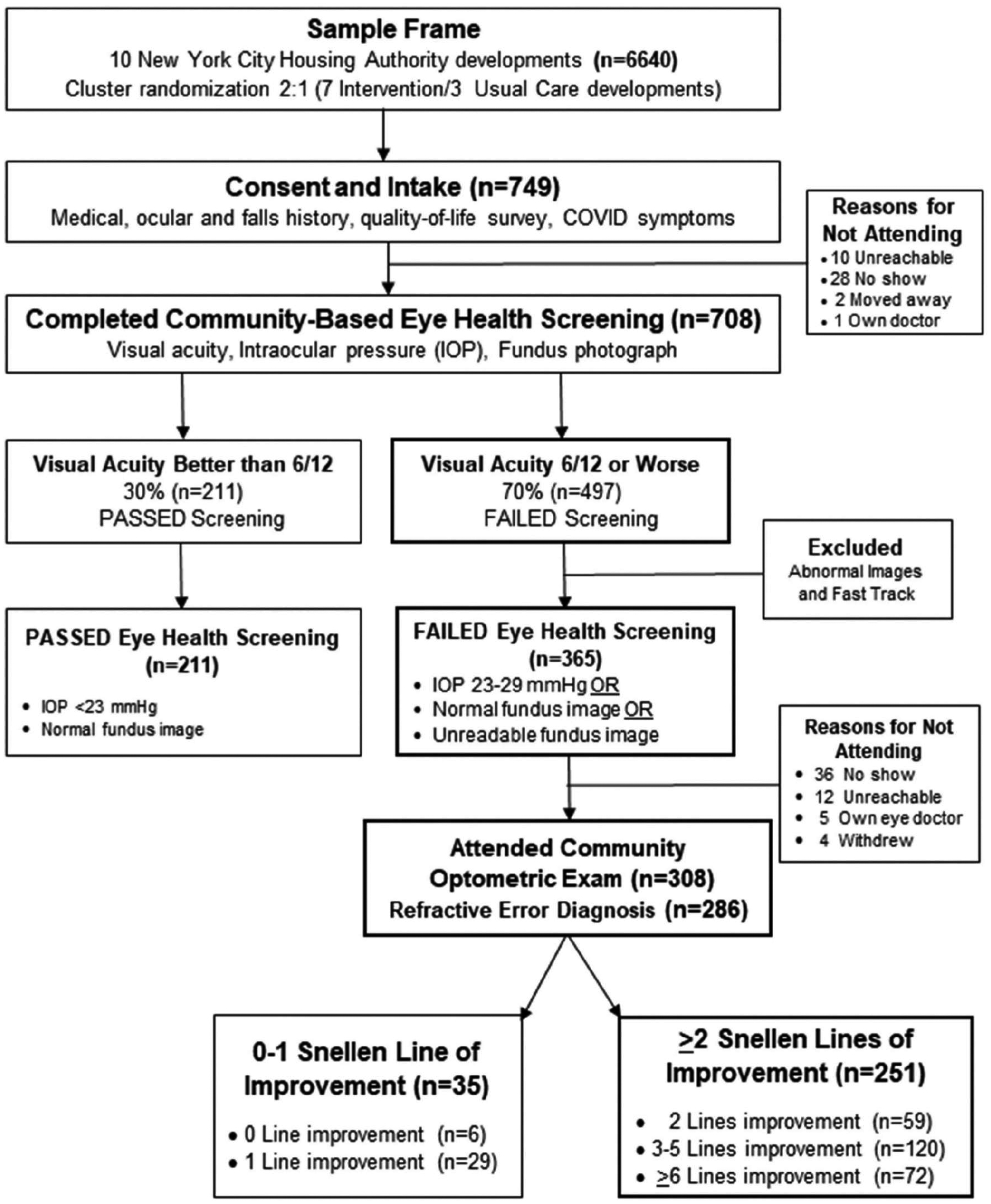
A sub-analysis of vision impairment and refractive error results within a 5-year prospective, cluster-randomised clinical trial. Eligible individuals (age ≥40 years) were recruited from 10 affordable housing developments in Upper Manhattan. Developments were randomised into usual care (received glasses prescription only) and intervention (free glasses) groups. Participants with 6/12 visual acuity or worse, intraocular pressure 23–29 mmHg, or an unreadable fundus image were scheduled with the study optometrist for refraction and a non-dilated exam. Visual improvement data were obtained by comparing the presenting acuity at screening compared to the best corrected acuity after refraction by the optometrist. Chi-square, two-sample t-tests, and a stepwise multivariate logistic regression model were used to determined factors associated with improvable visual impairment.
Results:
Seven hundred and eight participants completed screening, 308 received an optometric exam. Those with improvable vision impairment (n = 251), mean age: 69.8 years, 70.5% female, 53% African American, 39.8% Hispanic, >95% had health insurance. Refractive error diagnosed in 87.8% of the participants; lines of improvement: 2 lines (n = 59), 3 to 5 lines (n = 120), and ≥6 lines (n = 72). Stepwise multivariate logistic regression analysis showed that participants with visual acuity 6/12 or worse (odds ratio 16.041, 95% confidence interval 6.009 to 42.822, p = 0.000) or a normal fundus image (odds ratio 2.783, 95% confidence interval 1.001 to 7.740, p = 0.05) had significantly higher odds of improvable vision impairment.
Conclusion:
This innovative, targeted community-based study included an optometrist who detected high rates of refractive error and improvable vision impairment in an underserved population living in New York City. -
Keywords:
-
Source:Clin Exp Optom. :1-8
-
Pubmed ID:38452798
-
Pubmed Central ID:PMC11728945
-
Document Type:
-
Funding:
-
Download URL:
-
File Type:
 [PDF - 667.95 KB]
 -
Collection(s):
-
Main Document Checksum:urn:sha-512:5804508e5b0f2a7e3cb00c64a91a87600c8e1c7292f5e41fb241ddf7fd6f459b1ff2bdb2da2ae73a4fef705197052e108594156eecfab13510a316fea2520f72

Supporting Files


File Language:
English
 Was this page helpful?
 Found an issue?

CDC STACKS serves as an archival repository of CDC-published products including
scientific findings, journal articles, guidelines, recommendations, or other public health information authored or
co-authored by CDC or funded partners.
As a repository, CDC STACKS retains documents in their original published format to ensure public access to scientific information.
As a repository, CDC STACKS retains documents in their original published format to ensure public access to scientific information.
You May Also Like
COLLECTION
CDC Public Access