



Determinants of urinary dialkyl phosphate metabolites in midlife women: the Study of Women’s Health Across the Nation Multi-Pollutant Study (SWAN-MPS)
Supporting Files

-
5 08 2024
-
File Language:
English
Details
-
Alternative Title:J Expo Sci Environ Epidemiol
-
Personal Author:
-
Description:BACKGROUND:
Biomonitoring data and determinants of urinary dialkylphosphate (DAP) metabolites, markers of organophosphate pesticides, in racially diverse, non-occupationally exposed populations are scarce.
OBJECTIVE:
This study evaluated urinary concentrations and potential determinants of DAP metabolites of organophosphate pesticides in a multi-site, multi-racial/ethnic cohort of women aged 45–56 years, the Study of Women’s Health Across the Nation Multi-Pollutant Study (SWAN-MPS).
METHODS:
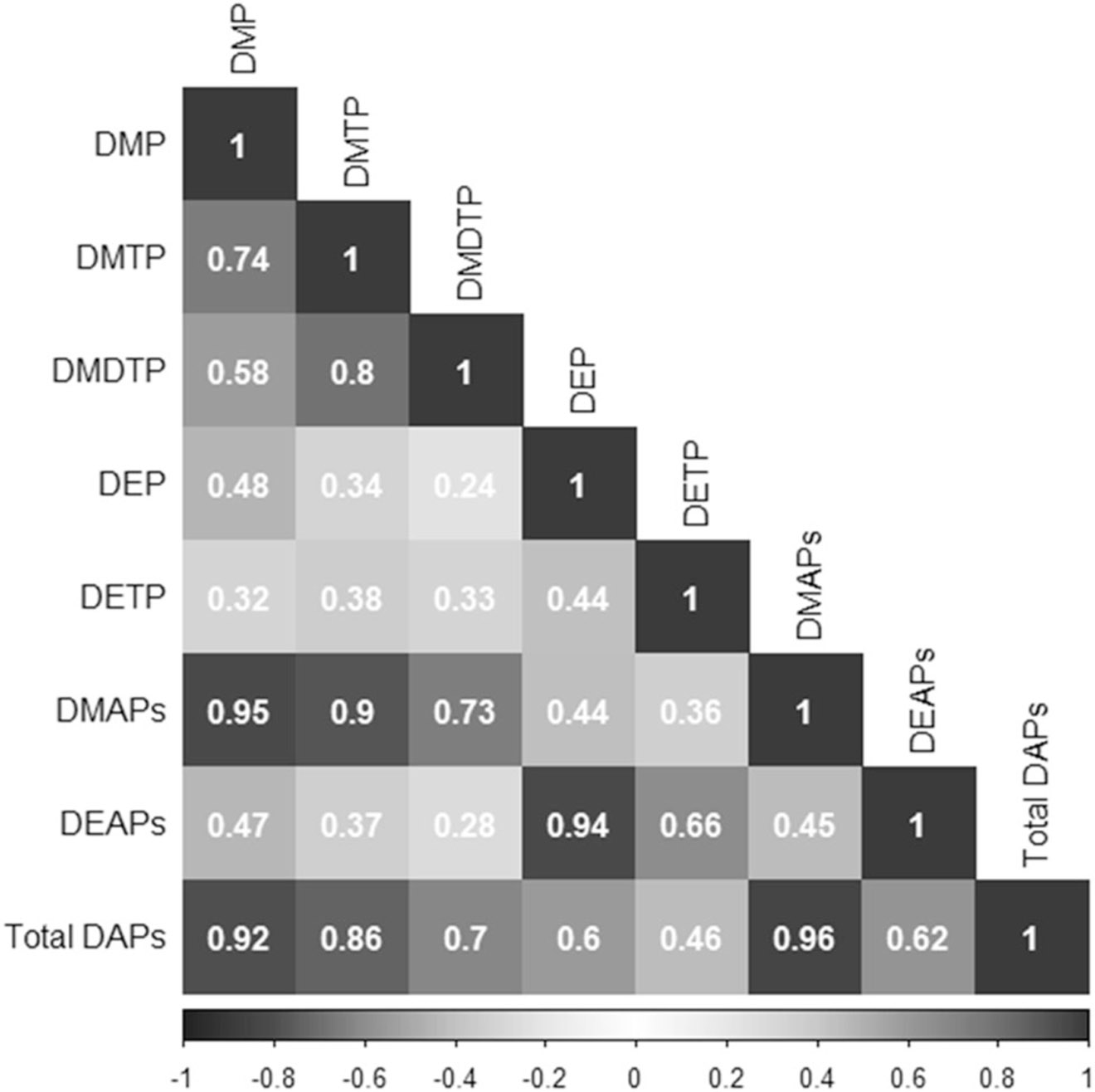
We analyzed 963 urine samples collected in 1999–2000, the baseline of SWAN-MPS for longitudinal studies, and quantified DAP metabolites, including dimethyl alkylphosphates (DMAPs): dimethylphosphate (DMP), dimethylthiophosphate (DMTP), dimethyldithiophosphate (DMDTP); and diethyl alkylphosphates (DEAPs): diethylphosphate (DEP), diethylthiophosphate (DETP), diethyldithiophosphate (DEDTP), using gas chromatography and triple quadrupole mass spectroscopy. Adjusted least squared geometric means (LSGMs) and 95% confidence intervals (CIs) were computed to compare DAP concentrations by sociodemographic, behavioral and dietary factors.
RESULTS:
The geometric means (geometric standard deviations) of total DAPs, DMAPs, and DEAPs were 141 (2.63) nmol/L, 102 (2.99) nmol/L, and 26.8 (2.46) nmol/L, respectively. Body mass index (BMI) was inversely associated with DMAPs and DEAPs: LSGM (95% CI) = 68.8 (55.7–84.9) and 21.0 (17.7–25.0) nmol/L for women with obesity vs. 102 (84.7–123) and 30.1 (25.7–35.1) nmol/L for women with normal/underweight, respectively. Fruit consumption was positively (74.9 (62.1–90.2) for less than 5–6 servings/week vs. 105 (84.8–130) nmol/L for 1 serving/day and more) whereas meat consumption was inversely associated with DMAPs (110 (95.0–128) for seldom vs. 82.3 (59.5–114) nmol/L for often consumption). Fresh apple consumption appears to be attributed to the DMAP differences. Alcohol consumption was positively associated with DEAPs (27.5 (23.1–32.7) for 2 drinks/week and more vs. 23.0 (20.0–26.6) nmol/L for less than 1 drink/month). Black women had higher concentrations of DEAPs compared with White women (27.3 (21.2–35.2) vs. 23.2 (20.2–26.7) nmol/L).
IMPACT STATEMENT:
Organophosphate pesticides (OPs) are synthetic chemicals and currently the most widely used type of insecticides. We examined multi-site, multi-ethnic cohort of midlife women in the U.S. that offers a unique opportunity to evaluate major determinants of OP exposure. We improved OP metabolite detection rates and obtained accurate concentrations using an improved analytical technique. Our findings suggest that consumptions of fruit, meat and alcohol are important determinants of OP exposure for midlife women. Higher concentrations of diethyl OP metabolites in Black women compared to White women, even after accounting for dietary intake, suggests additional, but unknown racial-ethnic differences that affect exposure.
-
Keywords:
-
Source:J Expo Sci Environ Epidemiol.
-
Pubmed ID:38719906
-
Pubmed Central ID:PMC11720950
-
Document Type:
-
Funding:T42 OH008455/OH/NIOSH CDC HHSUnited States/ ; R01 ES035087/ES/NIEHS NIH HHSUnited States/ ; U01 AG012554/AG/NIA NIH HHSUnited States/ ; UL1 RR024131/RR/NCRR NIH HHSUnited States/ ; P30 ES017885/ES/NIEHS NIH HHSUnited States/ ; U01 AG012505/AG/NIA NIH HHSUnited States/ ; T32 ES007062/ES/NIEHS NIH HHSUnited States/ ; U01 AG012535/AG/NIA NIH HHSUnited States/ ; U01 AG012553/AG/NIA NIH HHSUnited States/ ; U01 NR004061/NR/NINR NIH HHSUnited States/ ; U01 AG012539/AG/NIA NIH HHSUnited States/ ; R01 ES026578/ES/NIEHS NIH HHSUnited States/ ; U01 AG012546/AG/NIA NIH HHSUnited States/ ; U19 AG063720/AG/NIA NIH HHSUnited States/ ; U01 AG012495/AG/NIA NIH HHSUnited States/ ; U01 AG012531/AG/NIA NIH HHSUnited States/ ; R01 ES026964/ES/NIEHS NIH HHSUnited States/ ; U01 AG017719/AG/NIA NIH HHSUnited States/
-
Collection(s):
-
Main Document Checksum:urn:sha-512:8a0b6f0b0e503592357724d333fee8b7981879ad29dc732b451ecbb698e119a6a9228c178502744ed87dac27ee6d1d1bf5042ea47cf108e000b8834a1c06150d
-
Download URL:
-
File Type:
 [PDF
- 626.68 KB
]
[PDF
- 626.68 KB
]

Supporting Files


File Language:
English
 Was this page helpful?
 Found an issue?


CDC STACKS serves as an archival repository of CDC-published products including
scientific findings,
journal articles, guidelines, recommendations, or other public health information authored or
co-authored by CDC or funded partners.
As a repository, CDC STACKS retains documents in their original published format to ensure public access to scientific information.
As a repository, CDC STACKS retains documents in their original published format to ensure public access to scientific information.
You May Also Like
COLLECTION
CDC Public Access