



Still- and Live Births in the Periviable Period
Supporting Files

-
9 2020
-
File Language:
English
Details
-
Alternative Title:Ann Epidemiol
-
Personal Author:
-
Description:Purpose:
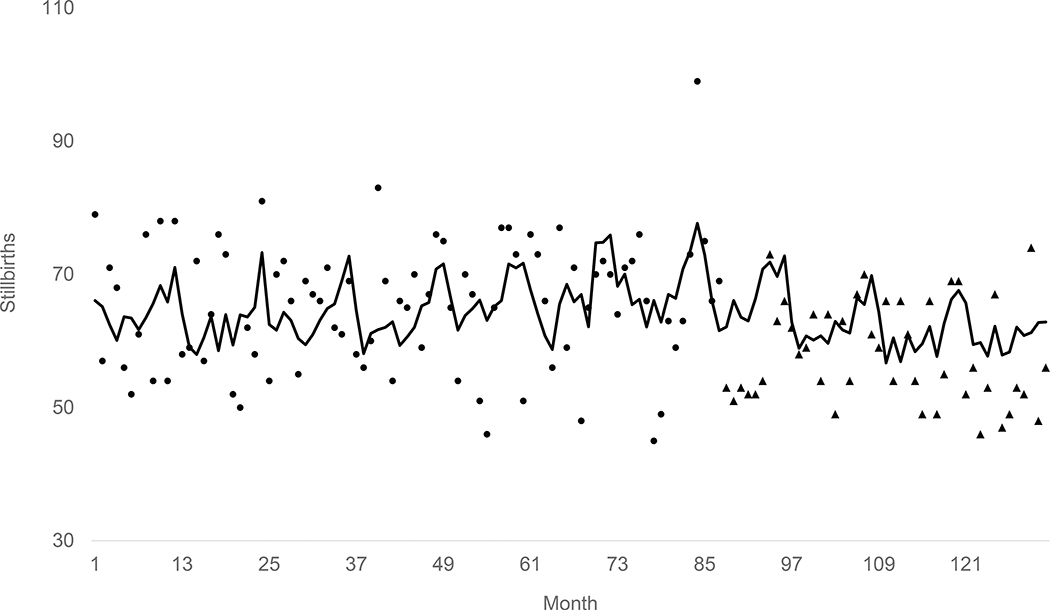
Infants born before 26 complete weeks of gestation represent fewer than 1% of live births in the US but account for roughly 40% of infant mortality and 20% of hospital-based obstetric costs. Ethicists and others have argued, but never tested, that these “periviable” births increased early in the 21st century when efforts to reduce stillbirth also increased. We use data from California, where 13% of US births occur, to address two questions implied by this argument. First, did stillbirths decline in the first decade of the 21st century? Second, if stillbirths did decline, did periviable live births increase simultaneously?
Methods:
Using data describing 37,440 singleton pregnancies in California that reached the 20 0/7 week of gestation but ended before 26 complete weeks of gestation, we constructed 240 monthly conception cohorts starting with that conceived in January 1991.We then answered our questions using Box-Jenkins time-series methods that address confounding by autocorrelation, including secular trends and seasonality.
Results:
We detected a downward shift in stillbirths in April 2007 that coincided with an upward shift in periviable live births.
Conclusions:
Our findings imply that, since 2007, fewer Californians than expected have had to contend with the sequelae of stillbirth, but more than expected have had to contend with those of periviable birth.
-
Subjects:
-
Keywords:
-
Source:Ann Epidemiol. 49:8-12
-
Pubmed ID:32648545
-
Pubmed Central ID:PMC8211124
-
Document Type:
-
Funding:
-
Volume:49
-
Collection(s):
-
Main Document Checksum:urn:sha-512:2f78d8ed338487ec29990487db1c5a65d6df849c1f690652f63344263d5f8d699406725a3ec2663b0cb57938e021686cbaa85ef14eddadd3c8b7709721a4c4c3
-
Download URL:
-
File Type:
 [PDF
- 446.85 KB
]
[PDF
- 446.85 KB
]
Supporting Files


File Language:
English
 Was this page helpful?
 Found an issue?
CDC STACKS serves as an archival repository of CDC-published products including
scientific findings,
journal articles, guidelines, recommendations, or other public health information authored or
co-authored by CDC or funded partners.
As a repository, CDC STACKS retains documents in their original published format to ensure public access to scientific information.
As a repository, CDC STACKS retains documents in their original published format to ensure public access to scientific information.
You May Also Like
COLLECTION
CDC Public Access