



Multiple Origins of Foot-and-Mouth Disease Virus Serotype Asia 1 Outbreaks, 2003–2007
Supporting Files
Public Domain

-
Jul 2009
File Language:
English
Details
-
Alternative Title:Emerg Infect Dis
-
Personal Author:Valarcher, Jean-Francois ; Knowles, Nick J. ; Zakharov, Valery ; Scherbakov, Alexey ; Zhang, Zhidong ; Shang, You-Jun ; Liu, Zai-Xin ; Liu, Xiang-Tao ; Sanyal, Aniket ; Hemadri, Divakar ; Tosh, Chakradhar ; Rasool, Thaha J. ; Pattnaik, Bramhadev ; Schumann, Kate R. ; Beckham, Tammy R. ; Linchongsubongkoch, Wilai ; Ferris, Nigel P. ; Roeder, Peter L. ; Paton, David J.
-
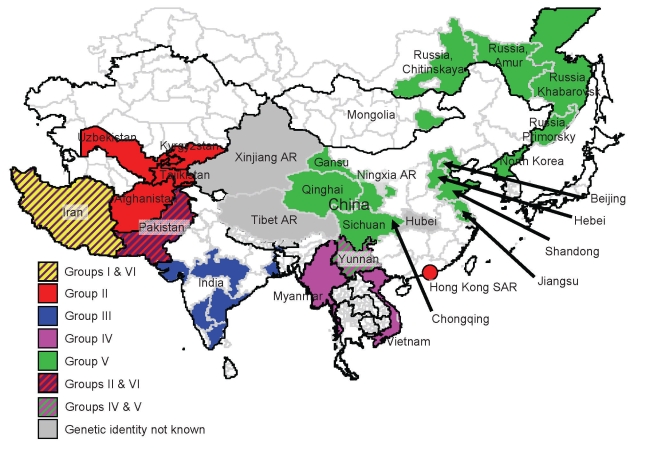
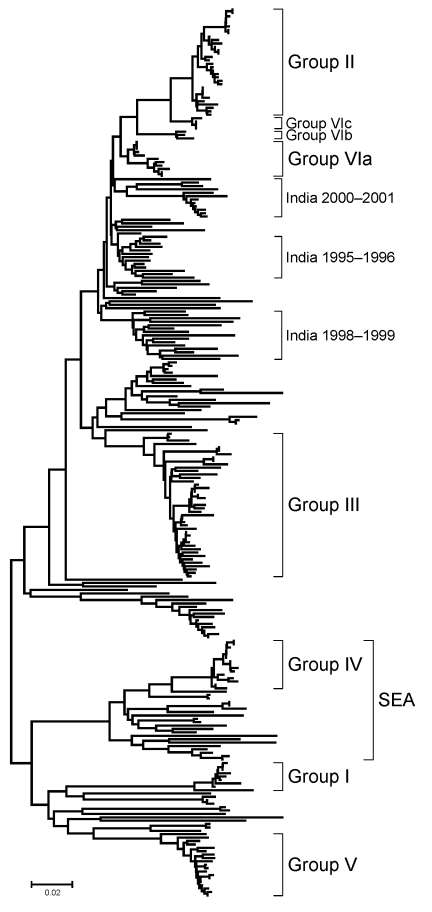
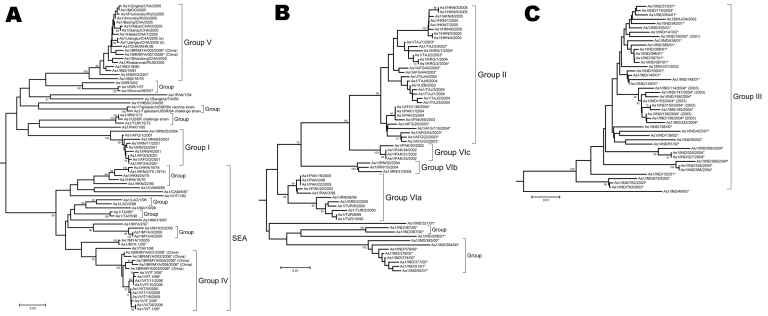
Description:We investigated the molecular epidemiology of foot-and-mouth disease virus (FMDV) serotype Asia 1, which caused outbreaks of disease in Asia during 2003-2007. Since 2004, the region affected by outbreaks of this serotype has increased from disease-endemic countries in southern Asia (Afghanistan, India, Iran, Nepal, Pakistan) northward to encompass Kyrgyzstan, Tajikistan, Uzbekistan, several regions of the People's Republic of China, Mongolia, Eastern Russia, and North Korea. Phylogenetic analysis of complete virus capsid protein 1 (VP1) gene sequences demonstrated that the FMDV isolates responsible for these outbreaks belonged to 6 groups within the Asia 1 serotype. Some contemporary strains were genetically closely related to isolates collected historically from the region as far back as 25 years ago. Our analyses also indicated that some viruses have spread large distances between countries in Asia within a short time.
-
Subjects:
-
Source:Emerg Infect Dis. 15(7):1046-1051.
-
Document Type:
-
Place as Subject:
-
Location:
-
Volume:15
-
Issue:7
-
Download URL:
-
File Type:
 [PDF - 596.54 KB]
 -
Collection(s):
-
Main Document Checksum:urn:sha256:c7f598e35acb1c0d75cdc69cd28652b0f4b8fc3e23be9c71f1c5ac37644cd886
Supporting Files


File Language:
English
 Was this page helpful?
 Found an issue?



CDC STACKS serves as an archival repository of CDC-published products including
scientific findings, journal articles, guidelines, recommendations, or other public health information authored or
co-authored by CDC or funded partners.
As a repository, CDC STACKS retains documents in their original published format to ensure public access to scientific information.
As a repository, CDC STACKS retains documents in their original published format to ensure public access to scientific information.
You May Also Like
COLLECTION
Emerging Infectious Diseases