



Risk Factors for Human Infection with Puumala Virus, Southwestern Germany
Supporting Files
Public Domain

-
2009/07/01
-
Series: Emerging Infectious Diseases
File Language:
English
Details
-
Journal Article:Emerging Infectious Diseases
-
Personal Author:
-
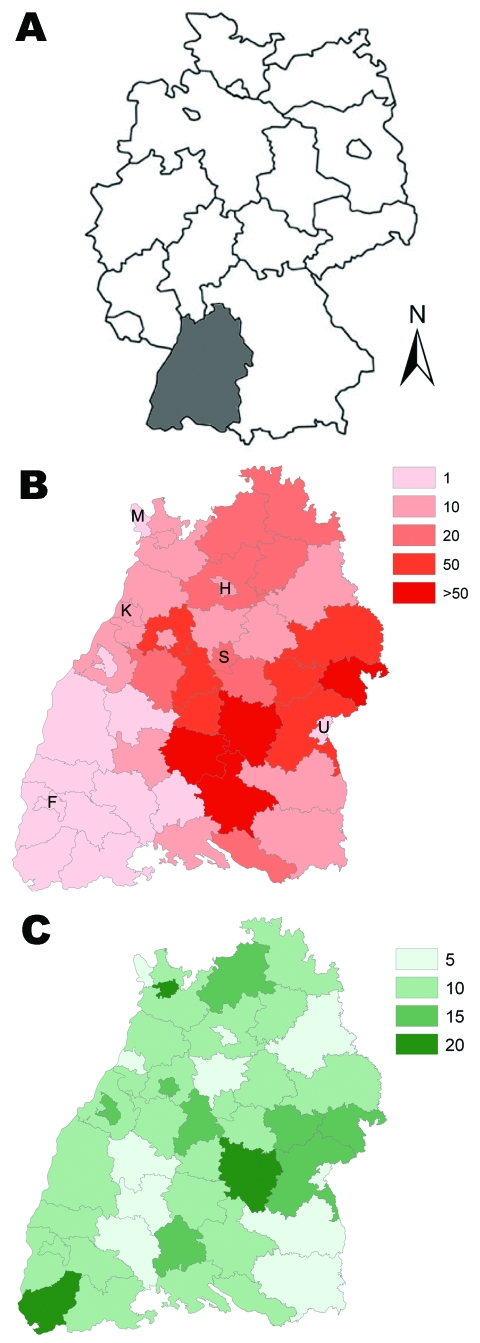
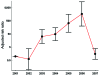
Description:Puumala virus, which causes nephropathia epidemica (NE), is the most prevalent hantavirus in Germany; bank voles serve as the main reservoir. During 2001-2007, most NE cases reported from Germany occurred in the southwestern state of Baden-Württemberg. We investigated the influence of bank vole habitats (beech forest, seed plants), vole food supply (beechnut mast), climate factors (winter and spring temperatures), and human population density on spatial and temporal occurrence of NE cases in Baden-Württemberg. Using Poisson-regression analyses, we found that all these factors influenced disease incidence. Furthermore, an independent trend of increasing incidence predicted that incidence will nearly double each year. The regression model explained 75% of the annual variation in NE incidence. The results suggest that environmental drivers lead to increasing incidence of NE infections in the southern part or even other parts of Germany.
-
Subjects:
-
Series:
-
DOI:
-
ISSN:1080-6059 (digital) ; 1080-6040 (print)
-
Pubmed ID:19624917
-
Pubmed Central ID:PMC2744254
-
Document Type:
-
Genre:
-
Place as Subject:
-
Rights:Public Domain
-
Topic:
-
Location:
-
Volume:15
-
Issue:7
-
Citation:Emerg Infect Dis. 15(7):1032-1039.
-
Download URL:
-
File Type:
 [PDF - 605.04 KB]
 -
Collection(s):
-
Main Document Checksum:urn:sha-512:185b2e642b2093dca734b9324c550b1d0d10f5e8c4830fb3cf98c274d43197690744df87c61ff1713adde9c68ce798f2f745519f190bb266e2c0d3297d821ae4
Supporting Files


File Language:
English
 Was this page helpful?
 Found an issue?



CDC STACKS serves as an archival repository of CDC-published products including
scientific findings, journal articles, guidelines, recommendations, or other public health information authored or
co-authored by CDC or funded partners.
As a repository, CDC STACKS retains documents in their original published format to ensure public access to scientific information.
As a repository, CDC STACKS retains documents in their original published format to ensure public access to scientific information.
You May Also Like
COLLECTION
Emerging Infectious Diseases