



Hemorrhagic Fever with Renal Syndrome Caused by 2 Lineages of Dobrava Hantavirus, Russia
Supporting Files
Public Domain

-
2008/04/01
-
Series: Emerging Infectious Diseases
File Language:
English
Details
-
Journal Article:Emerging Infectious Diseases
-
Personal Author:
-
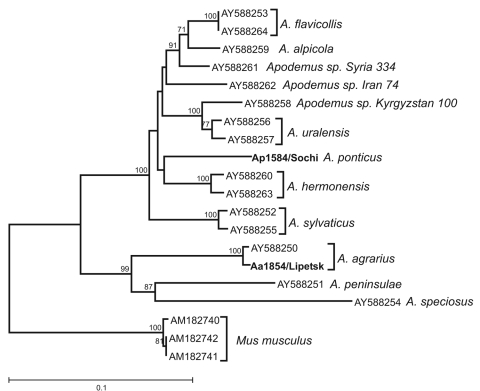
Description:Dobrava-Belgrade virus (DOBV) is a European hantavirus that causes hemorrhagic fever with renal syndrome (HFRS); case-fatality rates in Balkan countries are as high as 12%. To determine causative agents, we examined 126 cases of DOBV-associated HFRS in central and southern European Russia. In central Russia (Lipetsk, Voronezh, Orel regions), outbreaks were caused by a DOBV variant (DOBV-Aa) carried by Apodemus agrarius. In southern Russia (Sochi district), where HFRS is endemic, HFRS cases were caused by a new DOBV variant (DOBV-Ap), found in A. ponticus, a novel hantavirus natural host. Both viruses, DOBV-Aa/Lipetsk and DOBV-Ap/Sochi, were isolated through Vero E6 cells, genetically characterized, and used for serotyping of the HFRS patients' serum. The clinical severity of HFRS caused by DOBV-Aa resembles that of HFRS caused by Puumala virus (mild to moderate); clinical severity of disease caused by DOBV-Ap infections is more often moderate to severe.
-
Subjects:
-
Keywords:
-
Series:
-
DOI:
-
ISSN:1080-6059 (digital) ; 1080-6040 (print)
-
Pubmed ID:18394280
-
Pubmed Central ID:PMC2570905
-
Document Type:
-
Genre:
-
Place as Subject:
-
Rights:Public Domain
-
Topic:
-
Location:
-
Volume:14
-
Issue:4
-
Citation:Emerg Infect Dis. 14(4):617-625.
-
Download URL:
-
File Type:
 [PDF - 325.98 KB]
 -
Collection(s):
-
Main Document Checksum:urn:sha-512:f41ce2915e26ec77c356769414e612e40af3c15d0fa7422c34f627caa7e01a1a3312dbfa2773428858cd0d8ebc44df7b6fc26e8938e7025f832b85e4a033920b
Supporting Files


File Language:
English
 Was this page helpful?
 Found an issue?




CDC STACKS serves as an archival repository of CDC-published products including
scientific findings, journal articles, guidelines, recommendations, or other public health information authored or
co-authored by CDC or funded partners.
As a repository, CDC STACKS retains documents in their original published format to ensure public access to scientific information.
As a repository, CDC STACKS retains documents in their original published format to ensure public access to scientific information.
You May Also Like
COLLECTION
Emerging Infectious Diseases