



Regional differences in autism and intellectual disability risk associated with cesarean section delivery
Supporting Files

-
2024/11/01
-
Available in CDC Stacks on November 17, 2024, 12:00 AM

File Language:
English
Details
-
Alternative Title:Autism Res
-
Personal Author:
-
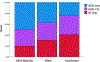
Description:Prior epidemiological studies investigating the association between delivery mode (i.e., vaginal birth and cesarean section C-section) and autism spectrum disorder (ASD) and intellectual disability (ID) risk have reported mixed findings. This study examined ASD and ID risks associated with primary and repeat C-section within diverse US regions. During even years 2000-2016, 8-years-olds were identified with ASD and/or ID and matched to birth records ASD only (N = 8566, 83.6% male), ASD + ID (N = 3445, 79.5% male), ID only (N = 6158, 60.8% male) using the Centers for Disease Control and Prevention's Autism and Developmental Disabilities Monitoring Network methodology. The comparison birth cohort (N = 1,456,914, 51.1% male) comprised all births recorded in the National Center for Health Statistics corresponding to birth years and counties in which surveillance occurred. C-section rates in the birth cohort demonstrated significant regional variation with lowest rates in the West. Overall models demonstrate increased odds of disability associated with primary and repeat C-section. Adjusted models, stratified by region, identified significant variability in disability likelihood associated with repeat C-section: increased odds occurred for all case groups in the Southeast, for ASD only and ID only in the Mid-Atlantic, and no case groups in the West. Regional variability in disability risk associated with repeat C-section coincides with differences in birth cohorts' C-section rates. This suggests increased likelihood of disability is not incurred by the procedure itself, but rather C-section serves as a proxy for exposures with regional variability that influence fetal development and C-section rates.
-
Subjects:
-
Keywords:
-
Source:Autism Res. 17(11):2418-2429
-
Pubmed ID:39420702
-
Pubmed Central ID:PMC11568895
-
Document Type:
-
Funding:
-
Genre:
-
Volume:17
-
Issue:11
-
Download URL:
-
File Type:
 [PDF - 1.01 MB]
 -
Collection(s):
-
Main Document Checksum:urn:sha-512:f919ef649a41ab01fe8ba2e725dcc14c6bdd925d619e1aff84f52716deaf1b9d345af6722e7dbef4737bf59dc5e1e3f13f4cd2e74c4fcc07ee71744f74ef6af7
Supporting Files


File Language:
English
 Was this page helpful?
 Found an issue?




CDC STACKS serves as an archival repository of CDC-published products including
scientific findings, journal articles, guidelines, recommendations, or other public health information authored or
co-authored by CDC or funded partners.
As a repository, CDC STACKS retains documents in their original published format to ensure public access to scientific information.
As a repository, CDC STACKS retains documents in their original published format to ensure public access to scientific information.
You May Also Like
COLLECTION
CDC Public Access