



Progress and Disparities in Early Identification of Autism Spectrum Disorder: Autism and Developmental Disabilities Monitoring Network, 2002–2016
Supporting Files

-
7 2022 ; 7-2022
-
Available in CDC Stacks on August 05, 2022, 12:00 AM

File Language:
English
Details
-
Alternative Title:J Am Acad Child Adolesc Psychiatry
-
Personal Author:
-
Description:Objective:
Early identification can improve outcomes for children with autism spectrum disorder (ASD). We sought to assess changes in early ASD identification over time and by co-occurring intellectual disability (ID) and race/ethnicity.
Method:
Using data for 2002–2016 from a biennial population-based ASD surveillance program among 8-year-old children in the United States, we defined identification as a child’s earliest recorded ASD diagnosis or special education eligibility. Unidentified children had characteristics meeting the ASD surveillance case definition but no recorded identification by age 8 years. We calculated median age at identification among identified children, median age at identification including unidentified children, and cumulative incidence of identification by age 48 months.
Results:
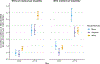
ASD identification by age 48 months was 4 times (95% CI: 3.6–4.3) as likely in 2016 as in 2002, with the largest increases among children without ID. Median age at ASD identification among identified children decreased 3 months during this time. Children of every race/ethnicity were more likely to be identified over time. There were racial disparities stratified by ID: in 2016, Black and Hispanic children without ID were less likely to be identified with ASD than were White children (both groups risk ratio: 0.7; 95% CI: 0.5–0.8), but Black children were 1.5 times (95% CI: 1.3–1.9) as likely as White children to be identified with ASD and ID.
Conclusion:
Substantial progress has been made to identify more children with ASD early, despite minimal decrease in median age at diagnosis. Considerable disparities remain in early ASD identification by race/ethnicity and co-occurring intellectual disability. -
Subjects:
-
Keywords:
-
Source:J Am Acad Child Adolesc Psychiatry. 61(7):905-914
-
Pubmed ID:34838692
-
Pubmed Central ID:PMC9353949
-
Document Type:
-
Funding:
-
Volume:61
-
Issue:7
-
Download URL:
-
File Type:
 [PDF - 464.17 KB]
 -
Collection(s):
-
Main Document Checksum:urn:sha-512:0d4c17ef1ee21910727ca3d3da132d4f8c186641b5999b6cb793f895770344cd8d7cbd9135ae9a59461283cb38146150123262ede35cd3f6735c453843d300e6
Supporting Files


File Language:
English
 Was this page helpful?
 Found an issue?






CDC STACKS serves as an archival repository of CDC-published products including
scientific findings, journal articles, guidelines, recommendations, or other public health information authored or
co-authored by CDC or funded partners.
As a repository, CDC STACKS retains documents in their original published format to ensure public access to scientific information.
As a repository, CDC STACKS retains documents in their original published format to ensure public access to scientific information.
You May Also Like
COLLECTION
CDC Public Access