



Practical considerations for using low-cost sensors to assess wildfire smoke exposure in school and childcare settings
Supporting Files

-
5 10 2024
-
Available in CDC Stacks on November 10, 2025, 12:00 AM
File Language:
English
Details
-
Alternative Title:J Expo Sci Environ Epidemiol
-
Personal Author:
-
Description:Background
More frequent and intense wildfires will increase concentrations of smoke in schools and childcare settings. Low-cost sensors can assess fine particulate matter (PM2.5) concentrations with high spatial and temporal resolution.
Objective
We sought to optimize the use of sensors for decision-making in schools and childcare settings during wildfire smoke to reduce children’s exposure to PM2.5.
Methods
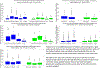
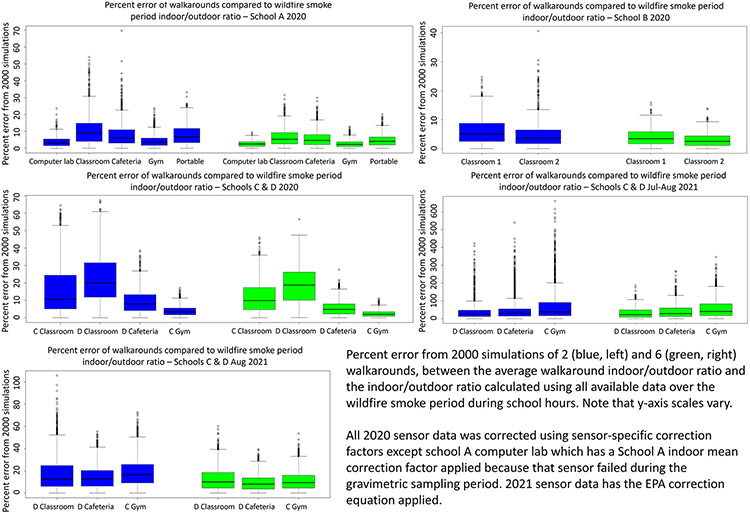
We measured PM2.5 concentrations indoors and outdoors at four schools in Washington State during wildfire smoke in 2020-2021 using low-cost sensors and gravimetric samplers. We randomly sampled 5-minute segments of low-cost sensor data to create simulations of brief portable handheld measurements.
Results
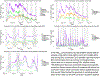
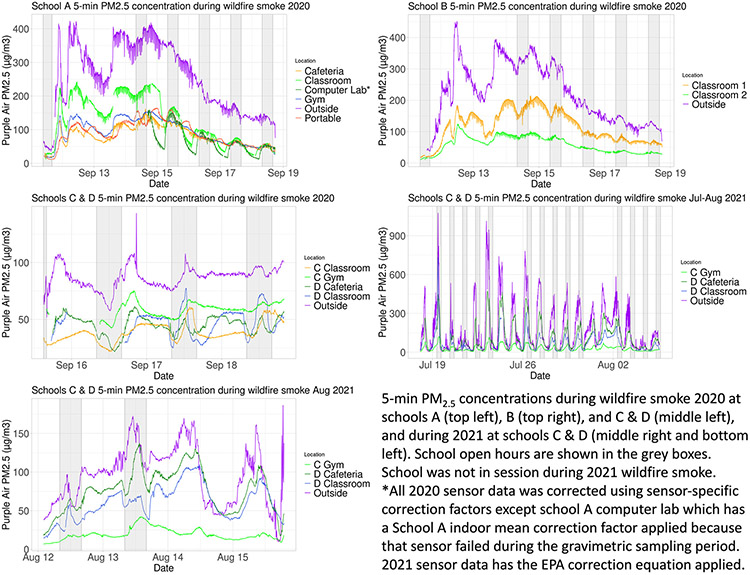
During wildfire smoke episodes (lasting 4-19 days), median hourly PM2.5 concentrations at different locations inside a single facility varied by up to 49.6 μg/m3 (maximum difference) during school hours. Median hourly indoor/outdoor ratios across schools ranged from 0.22 to 0.91. Within-school differences in concentrations indicated that it is important to collect measurements throughout a facility. Simulation results suggested that making handheld measurements more often and over multiple days better approximates indoor/outdoor ratios for wildfire smoke. During a period of unstable air quality, PM2.5 over the next hour indoors was more highly correlated with the last 10-minutes of data (mean R2 = 0.94) compared with the last 3-hours (mean R2 = 0.60), indicating that higher temporal resolution data is most informative for decisions about near-term activities indoors.
Significance
We found practical information for optimized sampling with low-cost sensors for wildfire smoke response. This information can be directly applied to schools and childcare settings to mitigate children’s exposure to PM2.5 from wildfire smoke. -
Keywords:
-
Source:J Expo Sci Environ Epidemiol.
-
Pubmed ID:38730039
-
Pubmed Central ID:PMC11550266
-
Document Type:
-
Funding:
-
Download URL:
-
File Type:
 [PDF - 1016.02 KB]
 -
Collection(s):
-
Main Document Checksum:urn:sha-512:10d14da1c434723d4d341454653e20e2c9bb6a71ad3154119e8e1a0af7c6a102b56e7ad1e1f03cbf5c2202e360e22644f81664faa5942ca3a608f7da4dc3d212
Supporting Files


File Language:
English
 Was this page helpful?
 Found an issue?

CDC STACKS serves as an archival repository of CDC-published products including
scientific findings, journal articles, guidelines, recommendations, or other public health information authored or
co-authored by CDC or funded partners.
As a repository, CDC STACKS retains documents in their original published format to ensure public access to scientific information.
As a repository, CDC STACKS retains documents in their original published format to ensure public access to scientific information.
You May Also Like
COLLECTION
CDC Public Access