



The dichotomy of threat and deprivation as subtypes of childhood maltreatment: Differential functional connectivity patterns of threat and reward circuits in an adult trauma sample
Supporting Files

-
2 2024 ; 2-2024
-
Available in CDC Stacks on 2025-02-01T00:00:00Z
File Language:
English
Details
-
Alternative Title:Biol Psychiatry Cogn Neurosci Neuroimaging
-
Personal Author:
-
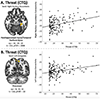
Description:Background: ; Childhood maltreatment is associated with reduced activation of the nucleus accumbens, a central region in the reward network, and overactivity in the amygdala, a key region in threat processing. However, the long-lasting impact of these associations in the context of later life stress is not well understood. The current study explored the association between childhood threat and deprivation and functional connectivity of threat- and reward-regions in an adult trauma sample. ; Methods: ; Trauma survivors (N=169, M age=32.2; SD=10.3; female=55.6%) were recruited from a Level I Trauma Center. Two-weeks post injury, participants completed the Childhood Trauma Questionnaire (measuring experiences of threat and deprivation) and underwent resting-state functional magnetic resonance imaging. Seed-to-voxel analyses evaluated the effect of childhood threat and deprivation on amygdala and nucleus accumbens resting-state connectivity. ; Results: ; Higher levels of threat were associated with increased connectivity between the right nucleus accumbens with temporal fusiform gyrus/parahippocampal gyrus and left amygdala and the precuneus (p<.05 FDR corrected). After controlling for posttraumatic symptoms two weeks post-trauma and lifetime trauma exposure, only the nucleus accumbens findings survived. There were no significant relationships between experiences of childhood deprivation and amygdala or nucleus accumbens connectivity. ; Discussion: ; Experiences of threat are associated with increased nucleus accumbens and amygdala connectivity, which may reflect a preparedness to detect salient and visual stimuli. This may also reflect a propensity towards dysregulated reward processing. Overall, these results suggest that childhood threat may be contributing to aberrant neural baseline reward and threat sensitivity later in life in an adult trauma sample.
-
Subjects:
-
Source:Biol Psychiatry Cogn Neurosci Neuroimaging. 9(2):227-234
-
Pubmed ID:37871776
-
Pubmed Central ID:PMC10922968
-
Document Type:
-
Funding:
-
Volume:9
-
Issue:2
-
Download URL:
-
File Type:
 [PDF - 225.05 KB]
 -
Collection(s):
-
Main Document Checksum:urn:sha-512:4e0bd1dd9aed4ec74c3bb81e923c6d59ac3ba141f3bcbe974a90e417c74d2f8b2d14bb8914adf36d682723a9fd412bd2001a950b225213f327737e9c85e9c453
Supporting Files


File Language:
English
 Was this page helpful?
 Found an issue?


CDC STACKS serves as an archival repository of CDC-published products including
scientific findings, journal articles, guidelines, recommendations, or other public health information authored or
co-authored by CDC or funded partners.
As a repository, CDC STACKS retains documents in their original published format to ensure public access to scientific information.
As a repository, CDC STACKS retains documents in their original published format to ensure public access to scientific information.
You May Also Like
COLLECTION
CDC Public Access