


Attributional negativity bias and acute stress disorder symptoms mediate the association between trauma history and future posttraumatic stress disorder
Supporting Files

-
8 2023
-
File Language:
English
Details
-
Alternative Title:J Trauma Stress
-
Personal Author:
-
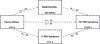
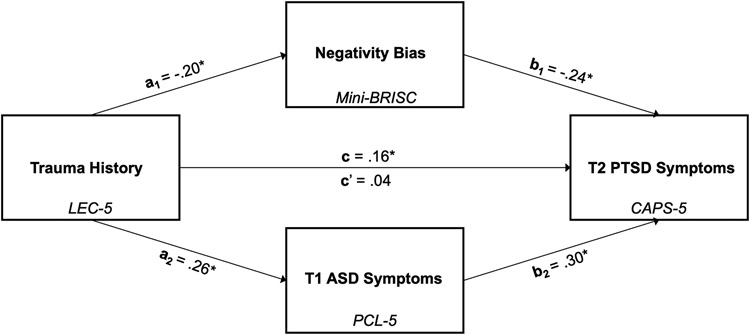
Description:Individuals who have experienced more trauma throughout their life have a heightened risk of developing posttraumatic stress disorder (PTSD) following injury. Although trauma history cannot be retroactively modified, identifying the mechanism(s) by which preinjury life events influence future PTSD symptoms may help clinicians mitigate the detrimental effects of past adversity. The current study proposed attributional negativity bias, the tendency to perceive stimuli/events as negative, as a potential intermediary in PTSD development. We hypothesized an association between trauma history and PTSD symptom severity following a new index trauma via heightened negativity bias and acute stress disorder (ASD) symptoms. Recent trauma survivors (N =189, 55.5% women, 58.7% African American/Black) completed assessments of ASD, negativity bias, and lifetime trauma 2-weeks postinjury; PTSD symptoms were assessed 6 months later. A parallel mediation model was tested with bootstrapping (10,000 resamples). Both negativity bias, Path b| : β = -.24, t(187) = -2.88, p = .004, and ASD symptoms, Path b| : β = .30, t(187) = 3.71, p < .001, fully mediated the association between trauma history and 6-month PTSD symptoms, full model: F(6, 182) = 10.95, p < .001, R | = .27; Path c': β = .04, t(187) = 0.54, p = .587. These results suggest that negativity bias may reflect an individual cognitive difference that can be further activated by acute trauma. Moreover, negativity bias may be an important, modifiable treatment target, and interventions addressing both acute symptoms and negativity bias in the early posttrauma period may weaken the link between trauma history and new-onset PTSD.
-
Subjects:
-
Source:J Trauma Stress. 36(4):785-795
-
Pubmed ID:37339014
-
Pubmed Central ID:PMC10528836
-
Document Type:
-
Funding:
-
Volume:36
-
Issue:4
-
Collection(s):
-
Main Document Checksum:urn:sha-512:515023f2fe144bff280981ac01110fbf867fc82a86d8c691cc32d6c40082323729d8e7af2ff7f3fa049a2998d6a228daa8080140a2ff2b67a8a257f69bbb8533
-
Download URL:
-
File Type:
 [PDF
- 395.02 KB
]
[PDF
- 395.02 KB
]
Supporting Files


File Language:
English
ON THIS PAGE

CDC STACKS serves as an archival repository of CDC-published products including
scientific findings,
journal articles, guidelines, recommendations, or other public health information authored or
co-authored by CDC or funded partners.
As a repository, CDC STACKS retains documents in their original published format to ensure public access to scientific information.
As a repository, CDC STACKS retains documents in their original published format to ensure public access to scientific information.
You May Also Like
COLLECTION
CDC Public Access