



A Prospective Study of Etiology of Childhood Acute Bacterial Meningitis, Europe
Supporting Files
Public Domain

-
Jul 2008
Details
-
Alternative Title:Emerg Infect Dis
-
Personal Author:Ceyhan, Mehmet ; Yildirim, Inci ; Balmer, Paul ; Borrow, Ray ; Dikici, Bunyamin ; Turgut, Mehmet ; Kurt, Nese ; Aydogan, Aysel ; Ecevit, Cigdem ; Anlar, Yasar ; Gulumser, Ozlem ; Tanir, Gonul ; Salman, Nuran ; Gurler, Nezahat ; Hatipoglu, Nevin ; Hacimustafaoglu, Mustafa ; Celebi, Solmaz ; Coskun, Yavuz ; Alhan, Emre ; Celik, Umit ; Camcioglu, Yildiz ; Secmeer, Gulten ; Gur, Deniz ; Gray, Steve
-
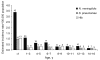
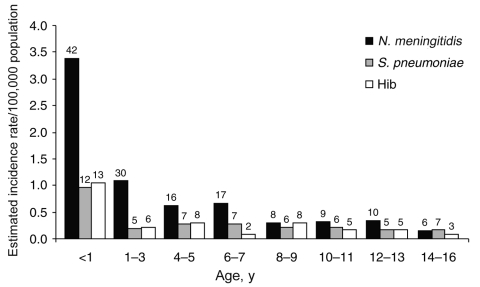
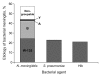
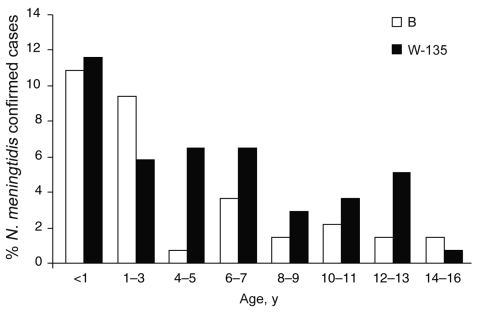
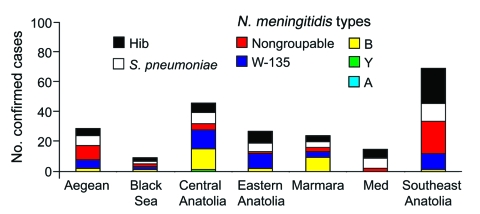
Description:Determination of the etiology of bacterial meningitis and estimating cost of disease are important in guiding vaccination policies. To determine the incidence and etiology of meningitis in Europe, cerebrospinal fluid (CSF) samples were obtained prospectively from children (1 month-17 years of age) with a clinical diagnosis of acute bacterial meningitis. Multiplex PCR was used to detect DNA evidence of Streptococcus pneumoniae, Haemophilus influenzae type b (Hib), and Neisseria meningitidis. In total, 408 CSF samples were collected, and bacterial etiology was determined in 243 cases; N. meningitidis was detected in 56.5%, S. pneumoniae in 22.5%, and Hib in 20.5% of the PCR-positive samples. Among N. meningitidis-positive CSF samples, 42.7%, 31.1%, 2.2%, and 0.7% belonged to serogroups W-135, B, Y, and A, respectively. This study highlights the emergence of serogroup W-135 disease in Europe and concludes that vaccines to prevent meningococcal disease in this region must provide reliable protection against this serogroup.
-
Subjects:
- Research
- Bacterial meningitis
- epidemiology
- Neisseria meningitidis
- serogroup W-135
- meningococcal vaccine
- research
- Adolescent
- Child
- Child, Preschool
- Female
- Haemophilus influenzae type b
- Humans
- Incidence
- Infant
- Male
- Meningitis, Bacterial
- Molecular Epidemiology
- Population Surveillance
- Prospective Studies
- Streptococcus pneumoniae
- Europe
-
Source:Emerg Infect Dis. 14(7):1089-1096.
-
Document Type:
-
Volume:14
-
Issue:7
-
Download URL:
-
File Type:
 [PDF - 296.25 KB]
 -
Collection(s):
-
Main Document Checksum:urn:sha256:41179a65a36c7665394bcca237a865a911d604117c2f2547fb810510d5ffa526
Supporting Files


 Was this page helpful?
 Found an issue?





CDC STACKS serves as an archival repository of CDC-published products including
scientific findings, journal articles, guidelines, recommendations, or other public health information authored or
co-authored by CDC or funded partners.
As a repository, CDC STACKS retains documents in their original published format to ensure public access to scientific information.
As a repository, CDC STACKS retains documents in their original published format to ensure public access to scientific information.
You May Also Like
COLLECTION
Emerging Infectious Diseases