



Hantavirus in Northern Short-Tailed Shrew, United States
Supporting Files
Public Domain

-
2007/09/01
-
Series: Emerging Infectious Diseases
File Language:
English
Details
-
Journal Article:Emerging Infectious Diseases
-
Personal Author:
-
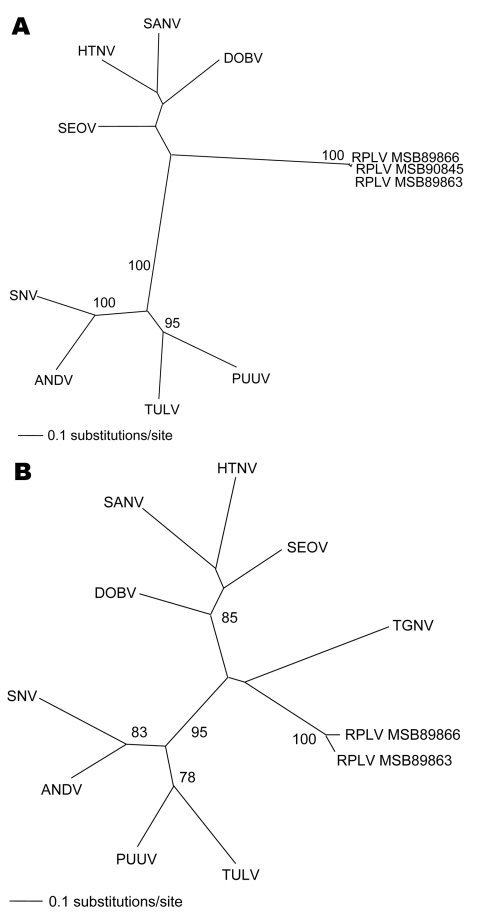
Description:Phylogenetic analyses, based on partial medium- and large-segment sequences, support an ancient evolutionary origin of a genetically distinct hantavirus detected by reverse transcription-PCR in tissues of northern short-tailed shrews (Blarina brevicauda) captured in Minnesota in August 1998. To our knowledge, this is the first evidence of hantaviruses harbored by shrews in the Americas.
-
Subjects:
-
Series:
-
DOI:
-
ISSN:1080-6059 (digital) ; 1080-6040 (print)
-
Pubmed ID:18252128
-
Pubmed Central ID:PMC2262104
-
Document Type:
-
Genre:
-
Place as Subject:
-
Rights:Public Domain
-
Topic:
-
Location:
-
Volume:13
-
Issue:9
-
Citation:Emerg Infect Dis. 13(9):1420-1423.
-
Download URL:
-
File Type:
 [PDF - 2.31 MB]
 -
Collection(s):
-
Main Document Checksum:urn:sha-512:6eaedd628e0e92bc077652935cd99c6222c3961cc71154ad5766b3836d809306506fb2a1732861e7c936802bf8d80778c9b77f271cb844b4cb9cd24306eedb44
Supporting Files


File Language:
English
 Was this page helpful?
 Found an issue?


CDC STACKS serves as an archival repository of CDC-published products including
scientific findings, journal articles, guidelines, recommendations, or other public health information authored or
co-authored by CDC or funded partners.
As a repository, CDC STACKS retains documents in their original published format to ensure public access to scientific information.
As a repository, CDC STACKS retains documents in their original published format to ensure public access to scientific information.
You May Also Like
COLLECTION
Emerging Infectious Diseases