



Confronting Potential Influenza A (H5N1) Pandemic with Better Vaccines
Supporting Files
Public Domain

-
Oct 2007
Details
-
Alternative Title:Emerg Infect Dis
-
Personal Author:
-
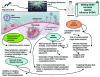
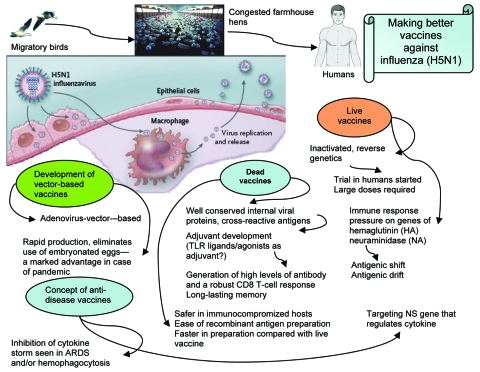
Description:Influenza A (H5N1) viruses are strong candidates for causing the next influenza pandemic if they acquire the ability for efficient human-to-human transmission. A major public health goal is to make efficacious vaccines against these viruses by using novel approaches, including cell-culture system, reverse genetics, and adjuvant development. Important consideration for the strategy includes preparation of vaccines from a currently circulating strain to induce broad-spectrum immunity toward newly emerged human H5 strains. This strategy would be a good solution early in a pandemic until an antigenically matched and approved vaccine is produced. The concept of therapeutic vaccines (e.g., antidisease vaccine) directed at diminishing the cytokine storm frequently seen in subtype H5N1-infected persons is underscored. Better understanding of host-virus interaction is essential to identify tools to produce effective vaccines against influenza (H5N1).
-
Subjects:
-
Source:Emerg Infect Dis. 13(10):1512-1518.
-
Document Type:
-
Volume:13
-
Issue:10
-
Download URL:
-
File Type:
 [PDF - 195.65 KB]
 -
Collection(s):
-
Main Document Checksum:urn:sha256:9078e38f2ddb72ab3a286831e60f78e5645ea6244a4b49d6bc79a5229c97e287
Supporting Files


 Was this page helpful?
 Found an issue?

CDC STACKS serves as an archival repository of CDC-published products including
scientific findings, journal articles, guidelines, recommendations, or other public health information authored or
co-authored by CDC or funded partners.
As a repository, CDC STACKS retains documents in their original published format to ensure public access to scientific information.
As a repository, CDC STACKS retains documents in their original published format to ensure public access to scientific information.
You May Also Like
COLLECTION
Emerging Infectious Diseases