



West Nile Virus Viremia in Eastern Chipmunks (Tamias striatus) Sufficient for Infecting Different Mosquitoes
Supporting Files
Public Domain

-
Jun 2007
Details
-
Alternative Title:Emerg Infect Dis
-
Personal Author:
-
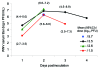
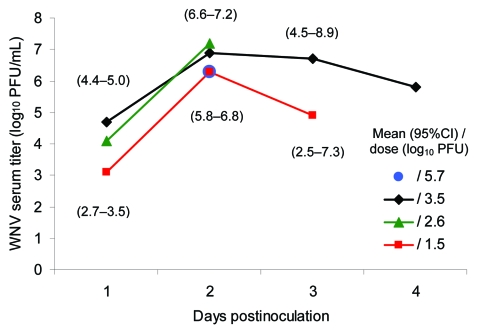
Description:In eastern chipmunks (Tamias striatus) inoculated intramuscularly with 101.5 to 105.7 PFU of West Nile virus (WNV), serum titers developed sufficient to infect Aedes triseriatus (Say), Ae. vexans (Meigen), and Culex pipiens (L.). Mean titers (95% confidence interval) of 8 chipmunks were 103.9(3.3-4.5), 106.7(6.4-7.0), and 105.8(4.1-7.5) PFU/mL on days 1-3 postinoculation (p.i.) and 105.8 PFU/mL in 1 chipmunk on day 4 p.i. Mean estimated days that WNV titers were >104.8 and >105.6 were 1.7 (1.1-2.3) and 1.4 (1.0-1.6). The longest period of viremia >104.8 PFU/mL was 3-4 days. WNV antigen was detected in the small intestine of 2 chipmunks and the kidneys of 4 chipmunks by immunohistochemistry. WNV also was detected in urine, saliva, and feces of some chipmunks. These data suggest chipmunks might play a role in enzootic WNV cycles and be an amplifying host for mosquitoes that could infect humans.
-
Subjects:
-
Source:Emerg Infect Dis. 13(6):831-837.
-
Document Type:
-
Volume:13
-
Issue:6
-
Download URL:
-
File Type:
 [PDF - 333.76 KB]
 -
Collection(s):
-
Main Document Checksum:urn:sha256:38d6a0a70bcd333ea34aba53ba16cbf5d5dd1e83956591b219e9b87cad0405fc
Supporting Files


 Was this page helpful?
 Found an issue?



CDC STACKS serves as an archival repository of CDC-published products including
scientific findings, journal articles, guidelines, recommendations, or other public health information authored or
co-authored by CDC or funded partners.
As a repository, CDC STACKS retains documents in their original published format to ensure public access to scientific information.
As a repository, CDC STACKS retains documents in their original published format to ensure public access to scientific information.
You May Also Like
COLLECTION
Emerging Infectious Diseases