



Community-associated Methicillin-resistant Staphylococcus aureus Isolates and Healthcare-Associated Infections1
Supporting Files

-
Feb 2007
File Language:
English
Details
-
Alternative Title:Emerg Infect Dis
-
Personal Author:
-
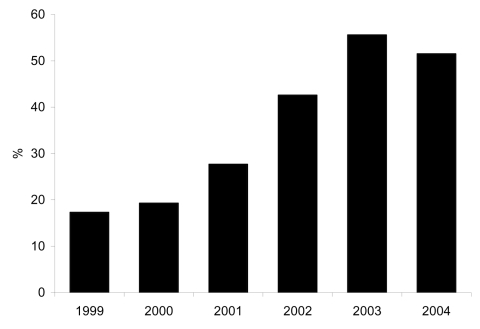
Description:We noted a marked increase in healthcare-associated (HA) methicillin-resistant Staphylococcus aureus (MRSA) infections caused by isolates phenotypically consistent with community-associated (CA)-MRSA strains. To study this trend, we retrospectively examined all HA-MRSA isolates from patients in our institution during 1999-2004. An isolate was considered an SCCmecIV phenotype if it had antimicrobial drug susceptibilities consistent with typical CA-MRSA isolates. Our phenotypic definition was validated in a limited subset of isolates by SCCmec genotype, pulsed-field gel electrophoresis, and multilocus sequence typing. Among 352 patients with HA-MRSA isolates, SCCmecIV phenotype increased from 17% in 1999 to 56% in 2003 (p < 0.0001). Antimicrobial drug-susceptibility phenotype and genotype were consistent in 21 (91%) of 23 isolates. In a multivariate model, the SCCmec type IV phenotype was independently associated with wound culture source, later year of collection, and MRSA isolated earlier during hospitalization. In conclusion, MRSA isolates phenotypically similar to CA strains have become the predominant isolates associated with HA-MRSA in our hospital.
-
Subjects:
-
Source:Emerg Infect Dis. 13(2):236-242.
-
Document Type:
-
Funding:
-
Volume:13
-
Issue:2
-
Download URL:
-
File Type:
 [PDF - 109.46 KB]
 -
Collection(s):
-
Main Document Checksum:urn:sha256:7fa7d3937d79ec20ab6ab12d259900c6c192c2259eaf9a95abeceee6c5d3ebdb
Supporting Files


File Language:
English
 Was this page helpful?
 Found an issue?

CDC STACKS serves as an archival repository of CDC-published products including
scientific findings, journal articles, guidelines, recommendations, or other public health information authored or
co-authored by CDC or funded partners.
As a repository, CDC STACKS retains documents in their original published format to ensure public access to scientific information.
As a repository, CDC STACKS retains documents in their original published format to ensure public access to scientific information.
You May Also Like
COLLECTION
Emerging Infectious Diseases