



Humans as Reservoir for Enterotoxin Gene–carrying Clostridium perfringens Type A
Supporting Files
Public Domain

-
Nov 2006
File Language:
English
Details
-
Alternative Title:Emerg Infect Dis
-
Personal Author:
-
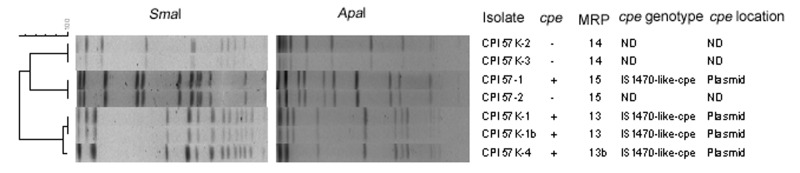
Description:We found a prevalence of 18% for enterotoxin gene-carrying (cpe+) Clostridium perfringens in the feces of healthy food handlers by PCR and isolated the organism from 11 of 23 PCR-positive persons by using hydrophobic grid membrane filter-colony hybridization. Several different cpe genotypes were recovered. The prevalence was 3.7% for plasmidial IS1151-cpe, 2.9% for plasmidial IS1470-like-cpe, 0.7% for chromosomal IS1470-cpe, and 1.5% for unknown cpe genotype. Lateral spread of cpe between C. perfringens strains was evident because strains from the same person carried IS1470-like cpe but shared no genetic relatedness according to pulsed-field gel electrophoresis analysis. Our findings suggest that healthy humans serve as a rich reservoir for cpe+ C. perfringens type A and may play a role in the etiology of gastrointestinal diseases caused by this organism. The results also indicate that humans should be considered a risk factor for spread of C. perfringens type A food poisoning and that they are a possible source of contamination for C. perfringens type A food poisoning.
-
Subjects:
-
Source:Emerg Infect Dis. 12(11):1724-1729.
-
Document Type:
-
Volume:12
-
Issue:11
-
Download URL:
-
File Type:
 [PDF - 243.32 KB]
 -
Collection(s):
-
Main Document Checksum:urn:sha256:981ff487deccba16652afddea93963183a99aa8a9b96db8862a7d601df3f28ec
Supporting Files


File Language:
English
 Was this page helpful?
 Found an issue?


CDC STACKS serves as an archival repository of CDC-published products including
scientific findings, journal articles, guidelines, recommendations, or other public health information authored or
co-authored by CDC or funded partners.
As a repository, CDC STACKS retains documents in their original published format to ensure public access to scientific information.
As a repository, CDC STACKS retains documents in their original published format to ensure public access to scientific information.
You May Also Like
COLLECTION
Emerging Infectious Diseases