



Cost-effectiveness of Algorithms for Confirmation Test of Human African Trypanosomiasis
Supporting Files
Public Domain

-
Oct 2007
File Language:
English
Details
-
Alternative Title:Emerg Infect Dis
-
Personal Author:
-
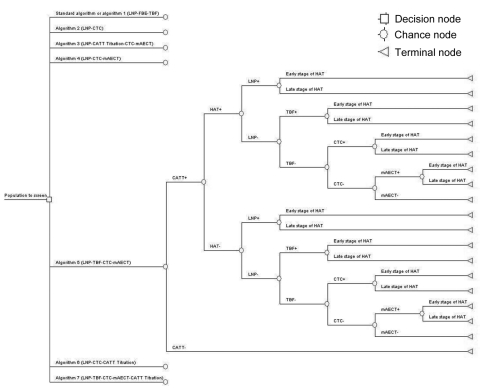
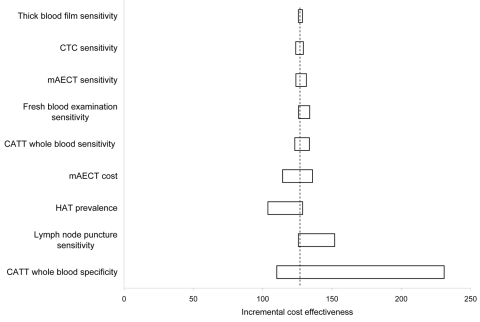
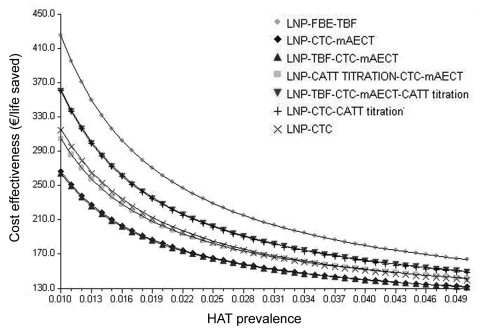
Description:The control of Trypanosoma brucei gambiense human African trypanosomiasis (HAT) is compromised by low sensitivity of the routinely used parasitologic confirmation tests. More sensitive alternatives, such as mini-anion exchange centrifugation technique (mAECT) or capillary tube centrifugation (CTC), are more expensive. We used formal decision analysis to assess the cost-effectiveness of alternative HAT confirmation algorithms in terms of cost per life saved. The effectiveness of the standard method, a combination of lymph node puncture (LNP), fresh blood examination (FBE), and thick blood film (TBF), was 36.8%; the LNP-FBE-CTC-mAECT sequence reached almost 80%. The cost per person examined ranged from euro1.56 for LNP-FBE-TBF to euro2.99 for LNP-TBF-CTC-mAECT-CATT (card agglutination test for trypanosomiasis) titration. LNP-TBF-CTC-mAECT was the most cost-effective in terms of cost per life saved. HAT confirmation algorithms that incorporate concentration techniques are more effective and efficient than the algorithms that are currently and routinely used by several T.b. gambiense control programs.
-
Subjects:
-
Source:Emerg Infect Dis. 13(10):1484-1490.
-
Document Type:
-
Place as Subject:
-
Volume:13
-
Issue:10
-
Download URL:
-
File Type:
 [PDF - 625.81 KB]
 -
Collection(s):
-
Main Document Checksum:urn:sha256:709362065dd6522bfa37dc65ebf214232f323bfe0884da8cd6b6626435658387
Supporting Files


File Language:
English
 Was this page helpful?
 Found an issue?


CDC STACKS serves as an archival repository of CDC-published products including
scientific findings, journal articles, guidelines, recommendations, or other public health information authored or
co-authored by CDC or funded partners.
As a repository, CDC STACKS retains documents in their original published format to ensure public access to scientific information.
As a repository, CDC STACKS retains documents in their original published format to ensure public access to scientific information.
You May Also Like
COLLECTION
Emerging Infectious Diseases