



Streptococcus suis Sequence Type 7 Outbreak, Sichuan, China
Supporting Files
Public Domain

-
Aug 2006
File Language:
English
Details
-
Alternative Title:Emerg Infect Dis
-
Personal Author:Ye, Changyun ; Zhu, Xiaoping ; Jing, Huaiqi ; Du, Huamao ; Segura, Mariela ; Zheng, Han ; Kan, Biao ; Wang, Lili ; Bai, Xuemei ; Zhou, Yongyun ; Cui, Zhigang ; Zhang, Shouying ; Jin, Dong ; Sun, Na ; Luo, Xia ; Zhang, Ji ; Gong, Zhaolong ; Wang, Xin ; Wang, Lei ; Sun, Hui ; Li, Zhenjun ; Sun, Qiangzheng ; Liu, Honglu ; Dong, Boqing ; Ke, Changwen ; Yuan, Hui ; Wang, Hua ; Tian, Kecheng ; Wang, Yu ; Gottschalk, Marcelo ; Xu, Jianguo
-
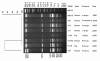
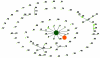
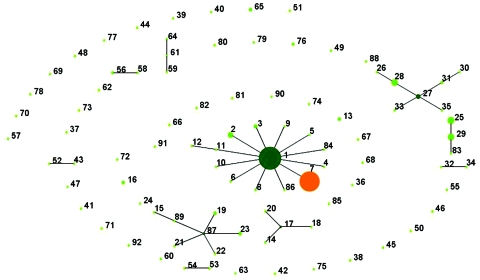
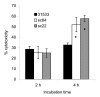
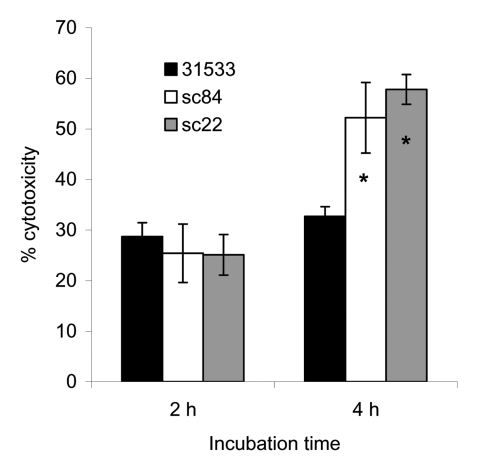
Description:An outbreak of Streptococcus suis serotype 2 emerged in the summer of 2005 in Sichuan Province, and sporadic infections occurred in 4 additional provinces of China. In total, 99 S. suis strains were isolated and analyzed in this study: 88 isolates from human patients and 11 from diseased pigs. We defined 98 of 99 isolates as pulse type I by using pulsed-field gel electrophoresis analysis of SmaI-digested chromosomal DNA. Furthermore, multilocus sequence typing classified 97 of 98 members of the pulse type I in the same sequence type (ST), ST-7. Isolates of ST-7 were more toxic to peripheral blood mononuclear cells than ST-1 strains. S. suis ST-7, the causative agent, was a single-locus variant of ST-1 with increased virulence. These findings strongly suggest that ST-7 is an emerging, highly virulent S. suis clone that caused the largest S. suis outbreak ever described.
-
Subjects:
-
Source:Emerg Infect Dis. 12(8):1203-1208.
-
Document Type:
-
Place as Subject:
-
Location:
-
Volume:12
-
Issue:8
-
Download URL:
-
File Type:
 [PDF - 192.08 KB]
 -
Collection(s):
-
Main Document Checksum:urn:sha256:6f45a680295aa05a3a4bc5eb10ca4e5213779ea416602287dec55e51b83127c7
Supporting Files


File Language:
English
 Was this page helpful?
 Found an issue?



CDC STACKS serves as an archival repository of CDC-published products including
scientific findings, journal articles, guidelines, recommendations, or other public health information authored or
co-authored by CDC or funded partners.
As a repository, CDC STACKS retains documents in their original published format to ensure public access to scientific information.
As a repository, CDC STACKS retains documents in their original published format to ensure public access to scientific information.
You May Also Like
COLLECTION
Emerging Infectious Diseases