



Disparities in Social Vulnerability and Premature Mortality among Decedents with Hepatitis B, United States, 2010–2019
Supporting Files

-
Available in CDC Stacks on 2025-09-12T00:00:00Z

File Language:
English
Details
-
Alternative Title:J Racial Ethn Health Disparities
-
Personal Author:
-
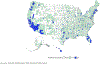
Description:Background ; Current US hepatitis B mortality rates remain three times higher than the national target. Mortality reduction will depend on addressing hepatitis B disparities influenced by social determinants of health. ; Objectives ; This study aims to describe characteristics of hepatitis B–listed decedents, which included US birthplace status and county social vulnerability attributes and quantify premature mortality. ; Methods ; We conducted a cross-sectional analysis of 17,483 hepatitis B–listed decedents using the 2010–2019 US Multiple-Cause-of-Death data merged with the county-level Social Vulnerability Index (SVI). Outcomes included the distribution of decedents according to US birthplace status and residence in higher versus lower death burden counties by sociodemographic characteristics, years of potential life lost (YPLL), and SVI quartiles. ; Results ; Most hepatitis B–listed decedents were US-born, male, and born during 1945–1965. Median YPLL was 17.2; 90.0% died prematurely. US-born decedents were more frequently White, non-college graduates, unmarried, and had resided in a county with < 500,000 people; non-US-born decedents were more frequently Asian/Pacific Islander, college graduates, married, and had resided in a county with ≥ 1 million people. Higher death burden (≥ 20) counties were principally located in coastal states. US-born decedents more frequently resided in counties in the highest SVI quartile for “Household Characteristics” and “Uninsured,” whereas non-US-born decedents more frequently resided in counties in the highest SVI quartile for “Racial/Ethnic Minority Status” and “Housing Type/Transportation.” ; Conclusion ; This analysis found substantial premature hepatitis B mortality and residence in counties ranked high in social vulnerability. Successful interventions should be tailored to disproportionately affected populations and the social vulnerability features of their geographic areas.
-
Keywords:
-
Source:J Racial Ethn Health Disparities.
-
Pubmed ID:38472630
-
Pubmed Central ID:PMC11390983
-
Document Type:
-
Funding:
-
Download URL:
-
File Type:
 [PDF - 829.31 KB]
 -
Collection(s):
-
Main Document Checksum:urn:sha-512:2910f9c0adaa8fc073e56b736d3edd0dc316ffe8be571d2b52b777a4b4a7f9034c206c3936c9620914fedea18eab8846adb5fe276717f84683a509592bb99473
Supporting Files


File Language:
English
 Was this page helpful?
 Found an issue?


CDC STACKS serves as an archival repository of CDC-published products including
scientific findings, journal articles, guidelines, recommendations, or other public health information authored or
co-authored by CDC or funded partners.
As a repository, CDC STACKS retains documents in their original published format to ensure public access to scientific information.
As a repository, CDC STACKS retains documents in their original published format to ensure public access to scientific information.
You May Also Like
COLLECTION
CDC Public Access