



Multidrug-resistant Commensal Escherichia coli in Children, Peru and Bolivia
Supporting Files
Public Domain

-
Jun 2006
File Language:
English
Details
-
Alternative Title:Emerg Infect Dis
-
Personal Author:Bartoloni, Alessandro ; Pallecchi, Lucia ; Benedetti, Marta ; Fernandez, Connie ; Vallejos, Yolanda ; Guzman, Elisa ; Villagran, Ana Liz ; Mantella, Antonia ; Lucchetti, Chiara ; Bartalesi, Filippo ; Strohmeyer, Marianne ; Bechini, Angela ; Gamboa, Herlan ; Rodríguez, Hugo ; Falkenberg, Torkel ; Kronvall, Göran ; Gotuzzo, Eduardo ; Paradisi, Franco ; Rossolini, Gian Maria
-
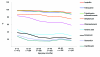
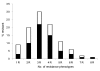
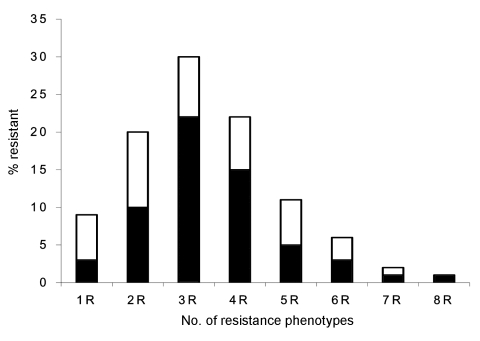
Description:Using a rapid screening method, we investigated the prevalence of fecal carriage of antimicrobial drug-resistant Escherichia coli in 3,174 healthy children from 4 urban settings in Peru and Bolivia. High resistance rates were observed for ampicillin (95%), trimethoprim-sulfamethoxazole (94%), tetracycline (93%), streptomycin (82%), and chloramphenicol (70%). Lower resistance rates were observed for nalidixic acid (35%), kanamycin (28%), gentamicin (21%), and ciprofloxacin (18%); resistance to ceftriaxone and amikacin was uncommon (<0.5%). In a random sample of 1,080 resistant E. coli isolates, 90% exhibited a multidrug-resistance (MDR) phenotype. The 2 most common MDR phenotypes (ampicillin/tetracycline/trimethoprim-sulfamethoxazole and ampicillin/tetracycline/trimethoprim-sulfamethoxazole/chloramphenicol) could be transferred en bloc in conjugation experiments. The most common acquired resistance genes were blaTEM, tet(A), tet(B), drfA8, sul1, sul2, and catI. These findings underscore the magnitude of the problem of antimicrobial drug resistance in low-resource settings and the urgent need for surveillance and control of this phenomenon.
-
Subjects:
-
Source:Emerg Infect Dis. 12(6):907-913.
-
Document Type:
-
Place as Subject:
-
Volume:12
-
Issue:6
-
Download URL:
-
File Type:
 [PDF - 187.67 KB]
 -
Collection(s):
-
Main Document Checksum:urn:sha256:fdfc04e1a2be63f28fc9f78f74da05d9040806b642186cef92cc83596aad5622
Supporting Files


File Language:
English
 Was this page helpful?
 Found an issue?



CDC STACKS serves as an archival repository of CDC-published products including
scientific findings, journal articles, guidelines, recommendations, or other public health information authored or
co-authored by CDC or funded partners.
As a repository, CDC STACKS retains documents in their original published format to ensure public access to scientific information.
As a repository, CDC STACKS retains documents in their original published format to ensure public access to scientific information.
You May Also Like
COLLECTION
Emerging Infectious Diseases