



Three-month symptom profiles among symptomatic adults with positive and negative SARS-CoV-2 tests: a prospective cohort study from the INSPIRE group
Supporting Files

-
5 03 2023 ; 5-03-
-
Available in CDC Stacks on August 29, 2024, 12:00 AM
File Language:
English
Details
-
Alternative Title:Clin Infect Dis
-
Personal Author:Spatz, Erica S. ; Gottlieb, Michael ; Wisk, Lauren E. ; Anderson, Jill ; Chang, Anna Marie ; Gentile, Nicole L. ; Hill, Mandy J. ; Huebinger, Ryan M. ; Idris, Ahamed H. ; Kinsman, Jeremiah ; Koo, Katherine ; Li, Shu-Xia ; McDonald, Samuel ; Plumb, Ian D. ; Rodriguez, Robert ; Saydah, Sharon ; Slovis, Benjamin ; Stephens, Kari A ; Unger, Elizabeth R. ; Wang, Ralph C. ; Yu, Huihui ; Hota, Bala ; Elmore, Joann G. ; Weinstein, Robert A. ; Venkatesh, Arjun
-
Description:BACKGROUND:
Long-term symptoms following SARS-CoV-2 infection are a major concern, yet their prevalence is poorly understood.
METHODS:
We conducted a prospective cohort study comparing adults with SARS-CoV-2 infection (COVID+) with adults who tested negative (COVID−), enrolled within 28 days of an FDA-approved SARS-CoV2 test result for active symptoms. Sociodemographic characteristics, symptoms of SARS-CoV-2 infection (assessed with the CDC Person Under Investigation Symptom List), and symptoms of post-infectious syndromes (i.e., fatigue, sleep quality, muscle/joint pains, unrefreshing sleep, and dizziness/fainting, assessed with CDC Short Symptom Screener for myalgic encephalomyelitis/chronic fatigue syndrome) were assessed at baseline and 3 months via electronic surveys sent via text or email.
RESULTS:
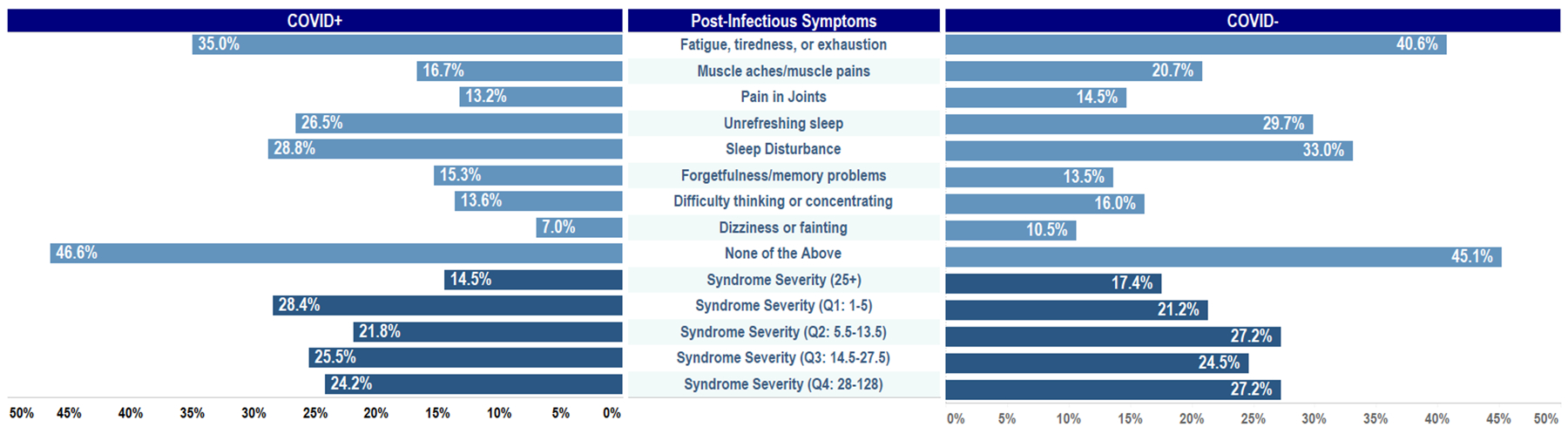
Among the first 1,000 participants, 722 were COVID+ and 278 were COVID−. Mean age was 41.5 (SD 15.2); 66.3% were female, 13.4% were Black, and 15.3% were Hispanic. At baseline, SARS-CoV-2 symptoms were more common in the COVID+ group than the COVID− group. At 3-months, SARS-CoV-2 symptoms declined in both groups although were more prevalent in the COVID+ group: upper respiratory symptoms/head/eyes/ears/nose/throat (HEENT; 37.3% vs 20.9%), constitutional (28.8% vs 19.4%), musculoskeletal (19.5% vs 14.7%), pulmonary (17.6% vs 12.2%), cardiovascular (10.0% vs 7.2%), and gastrointestinal (8.7% vs 8.3%); only 50.2% and 73.3% reported no symptoms at all. Symptoms of post-infectious syndromes were similarly prevalent among the COVID+ and COVID− groups at 3 months.
CONCLUSIONS:
Approximately half of COVID+ participants, as compared with one-quarter of COVID− participants, had at least one SARS-CoV-2 symptom at 3 months, highlighting the need for future work to distinguish Long COVID. -
Subjects:
-
Keywords:
-
Source:Clin Infect Dis. 76(9):1559-1566
-
Pubmed ID:36573005
-
Pubmed Central ID:PMC11361781
-
Document Type:
-
Funding:
-
Volume:76
-
Issue:9
-
Download URL:
-
File Type:
 [PDF - 760.15 KB]
 -
Collection(s):
-
Main Document Checksum:urn:sha-512:a3fceb989e60949ab30fd03aaa6d0151ae7207280ab6694d3d6dfc35c75f6237897c1d52b80316bdc4b67a49c042802e130c418431445b1d5d56bbfcba4c9147
Supporting Files


File Language:
English
 Was this page helpful?
 Found an issue?





CDC STACKS serves as an archival repository of CDC-published products including
scientific findings, journal articles, guidelines, recommendations, or other public health information authored or
co-authored by CDC or funded partners.
As a repository, CDC STACKS retains documents in their original published format to ensure public access to scientific information.
As a repository, CDC STACKS retains documents in their original published format to ensure public access to scientific information.
You May Also Like
COLLECTION
CDC Public Access