



Novel gentamicin resistance genes in Campylobacter isolated from humans and retail meats in the USA
Supporting Files

-
5 2015 ; 5-2015
-
Available in CDC Stacks on 2024-08-28T00:00:00Z
File Language:
English
Details
-
Alternative Title:J Antimicrob Chemother
-
Personal Author:Zhao, Shaohua ; Mukherjee, Sampa ; Chen, Yuansha ; Li, Cong ; Young, Shenia ; Warren, Melissa ; Abbott, Jason ; Friedman, Sharon ; Kabera, Claudine ; Karlsson, Maria ; McDermott, Patrick F.
-
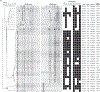
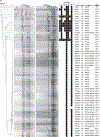
Description:Objectives: ; To understand the molecular epidemiology of gentamicin-resistant Campylobacter and investigate aminoglycoside resistance mechanisms. ; Methods: ; One-hundred-and-fifty-one gentamicin-resistant Campylobacter isolates from humans (n = 38 Campylobacter jejuni; n = 41, Campylobacter coli) and retail chickens (n = 72 C. coli), were screened for the presence of gentamicin resistance genes by PCR and subtyped using PFGE. A subset of the isolates (n = 41) was analysed using WGS. ; Results: ; Nine variants of gentamicin resistance genes were identified: aph(2′′)-Ib, Ic, Ig, If, If1, If3, Ih, aac(6′)-Ie/aph(2′′)-Ia and aac(6′)-Ie/aph(2′′)-If2. The aph(2′′)-Ib, Ic, If1, If3, Ih and aac(6′)-Ie/aph(2′′)-If2 variants were identified for the first time in Campylobacter. Human isolates showed more diverse aminoglycoside resistance genes than did retail chicken isolates, in which only aph(2′′)-Ic and -Ig were identified. The aph(2′′)-Ig gene was only gene shared by C. coli isolates from human (n = 27) and retail chicken (n = 69). These isolates displayed the same resistance profile and similar PFGE patterns, suggesting that contaminated retail chicken was probably the source of human C. coli infections. Human isolates were genetically diverse and generally more resistant than the retail chicken isolates. The most frequent co-resistance was to tetracycline (78/79, 98.7%), followed by ciprofloxacin/nalidixic acid (46/79, 58.2%), erythromycin and azithromycin (36/79, 45.6%), telithromycin (32/79, 40.5%) and clindamycin (18/79, 22.8%). All human and retail meat isolates were susceptible to florfenicol. ; Conclusions: ; This study demonstrated that several new aminoglycoside resistance genes underlie the recent emergence of gentamicin-resistant Campylobacter, and that, in addition to contaminated retail chicken, other sources have also contributed to gentamicin-resistant Campylobacter infections in humans.
-
Subjects:
- Animals
- Anti-Bacterial Agents
- Campylobacter Infections
- Campylobacter coli
- Campylobacter jejuni
- Chickens
- DNA, Bacterial
- Drug Resistance, Bacterial
- Electrophoresis, Gel, Pulsed-Field
- Genes, Bacterial
- Genome, Bacterial
- Gentamicins
- Humans
- Meat
- Molecular Typing
- Polymerase Chain Reaction
- Sequence Analysis, DNA
- United States
-
Keywords:
-
Source:J Antimicrob Chemother. 70(5):1314-1321
-
Pubmed ID:25645207
-
Pubmed Central ID:PMC11350565
-
Document Type:
-
Funding:
-
Volume:70
-
Issue:5
-
Download URL:
-
File Type:
 [PDF - 1.06 MB]
 -
Collection(s):
-
Main Document Checksum:urn:sha-512:f55b37f39cac86ed6a55df69277d97c2c722425571144cabf59e431b5113c96d9ddadf4ac52d06701defc35dff9acf69c14af1b2c9b27d12921e167a9cb0bd91
Supporting Files


File Language:
English
 Was this page helpful?
 Found an issue?



CDC STACKS serves as an archival repository of CDC-published products including
scientific findings, journal articles, guidelines, recommendations, or other public health information authored or
co-authored by CDC or funded partners.
As a repository, CDC STACKS retains documents in their original published format to ensure public access to scientific information.
As a repository, CDC STACKS retains documents in their original published format to ensure public access to scientific information.
You May Also Like
COLLECTION
CDC Public Access