



Bat-transmitted Human Rabies Outbreaks, Brazilian Amazon
Supporting Files
Public Domain

-
Aug 2006
File Language:
English
Details
-
Alternative Title:Emerg Infect Dis
-
Personal Author:da Rosa, Elizabeth S.T. ; Kotait, Ivanete ; Barbosa, Taciana F.S. ; Carrieri, Maria L. ; Brandão, Paulo E. ; Pinheiro, Amiraldo S. ; Begot, Alberto L. ; Wada, Marcelo Y. ; de Oliveira, Rosely C. ; Grisard, Edmundo C. ; Ferreira, Márcia ; Lima, Reynaldo J. da Silva ; Montebello, Lúcia ; Medeiros, Daniele B.A. ; Sousa, Rita C.M. ; Bensabath, Gilberta ; Carmo, Eduardo H. ; Vasconcelos, Pedro F.C.
-
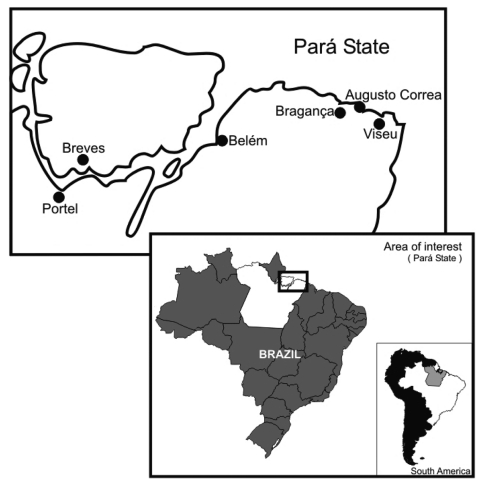
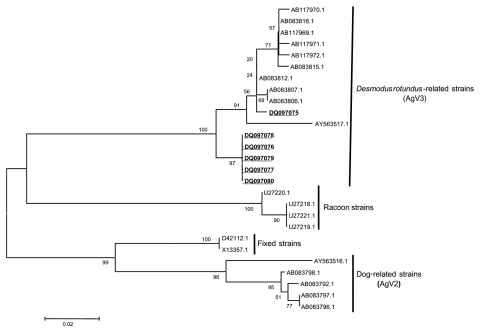
Description:We describe 2 bat-transmitted outbreaks in remote, rural areas of Portel and Viseu Municipalities, Pará State, northern Brazil. Central nervous system specimens were taken after patients' deaths and underwent immunofluorescent assay and histopathologic examination for rabies antigens; also, specimens were injected intracerebrally into suckling mice in an attempt to isolate the virus. Strains obtained were antigenically and genetically characterized. Twenty-one persons died due to paralytic rabies in the 2 municipalities. Ten rabies virus strains were isolated from human specimens; 2 other cases were diagnosed by histopathologic examination. Isolates were antigenically characterized as Desmodus rotundus variant 3 (AgV3). DNA sequencing of 6 strains showed that they were genetically close to D. rotundus-related strains isolated in Brazil. The genetic results were similar to those obtained by using monoclonal antibodies and support the conclusion that the isolates studied belong to the same rabies cycle, the virus variants found in the vampire bat D. rotundus.
-
Subjects:
-
Source:Emerg Infect Dis. 12(8):1197-1202.
-
Document Type:
-
Place as Subject:
-
Volume:12
-
Issue:8
-
Download URL:
-
File Type:
 [PDF - 289.50 KB]
 -
Collection(s):
-
Main Document Checksum:urn:sha256:1750f0df41b75e74b19e3b5cea163a70a46cce24393fa70826242485eceab192
Supporting Files


File Language:
English
 Was this page helpful?
 Found an issue?




CDC STACKS serves as an archival repository of CDC-published products including
scientific findings, journal articles, guidelines, recommendations, or other public health information authored or
co-authored by CDC or funded partners.
As a repository, CDC STACKS retains documents in their original published format to ensure public access to scientific information.
As a repository, CDC STACKS retains documents in their original published format to ensure public access to scientific information.
You May Also Like
COLLECTION
Emerging Infectious Diseases