



Patient and pharmacist perspectives on pharmacist-prescribed contraception: A systematic review ★
Supporting Files

-
2 2021 ; 2-2021
-
Available in CDC Stacks on July 28, 2024, 12:00 AM
File Language:
English
Details
-
Alternative Title:Contraception
-
Personal Author:
-
Description:Objective:
Increasingly, states authorize pharmacists to prescribe hormonal contraception to patients without a prescription from another healthcare provider. The purpose of this review is to investigate pharmacist and patient perspectives on pharmacist-prescribed contraception in the United States.
Study design:
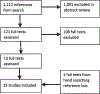
We searched Medline, Embase, PsycInfo, CINAHL, Scopus, and the Cochrane Library from inception through July 10, 2019. We included qualitative and mixed-methods studies, quantitative surveys, observational studies, and randomized trials in the United States. Risk of bias was assessed using tools for quantitative and qualitative studies.
Results:
Fifteen studies met inclusion criteria, including studies on pharmacists and student pharmacists (n = 9), patients (n = 5), and both (n = 1). Study samples ranged from local to national. Studies had moderate to high risk of bias, primarily due to low response rates and lack of validated instruments. Most pharmacists (57–96%) across four studies were interested in participating in pharmacist-prescribed contraception services. Among patients, 63–97% across three studies supported pharmacist-prescribed contraception, and 38–68% across four studies intended to participate in these services. At least half of pharmacists across four studies felt comfortable prescribing contraception, though pharmacists identified additional training needs. Pharmacists and patients identified several reasons for interest in pharmacist-prescribed contraception services, including increasing patient access, reducing unintended pregnancies, and offering professional development for pharmacists. They also identified barriers, including payment, time and resource constraints, liability, and patient health concerns.
Conclusions:
Most pharmacists and patients across 15 studies were interested in expanded access to contraception through pharmacist-prescribed contraception. Findings on facilitators and barriers may inform implementation efforts.
Implications:
Pharmacist-prescribed contraception is a strategy to expand patient access to contraception. Reducing barriers to implementation could improve participation among pharmacists and patients. -
Subjects:
-
Keywords:
-
Source:Contraception. 103(2):66-74
-
Pubmed ID:33130109
-
Pubmed Central ID:PMC11283818
-
Document Type:
-
Funding:
-
Volume:103
-
Issue:2
-
Download URL:
-
File Type:
 [PDF - 498.85 KB]
 -
Collection(s):
-
Main Document Checksum:urn:sha-512:24250eb1059f08b4e96b45a6a6282af09120ce62ff548bfe89ad94ff8d2cadce5900bd226f6b6adb5a484ba637eb74a70f68e0b0416cf484f0c1132c96809046
Supporting Files


File Language:
English
 Was this page helpful?
 Found an issue?


CDC STACKS serves as an archival repository of CDC-published products including
scientific findings, journal articles, guidelines, recommendations, or other public health information authored or
co-authored by CDC or funded partners.
As a repository, CDC STACKS retains documents in their original published format to ensure public access to scientific information.
As a repository, CDC STACKS retains documents in their original published format to ensure public access to scientific information.
You May Also Like
COLLECTION
CDC Public Access