



Predominance of Ancestral Lineages of Mycobacterium tuberculosis in India
Supporting Files
Public Domain

-
Sep 2006
File Language:
English
Details
-
Alternative Title:Emerg Infect Dis
-
Personal Author:
-
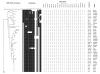
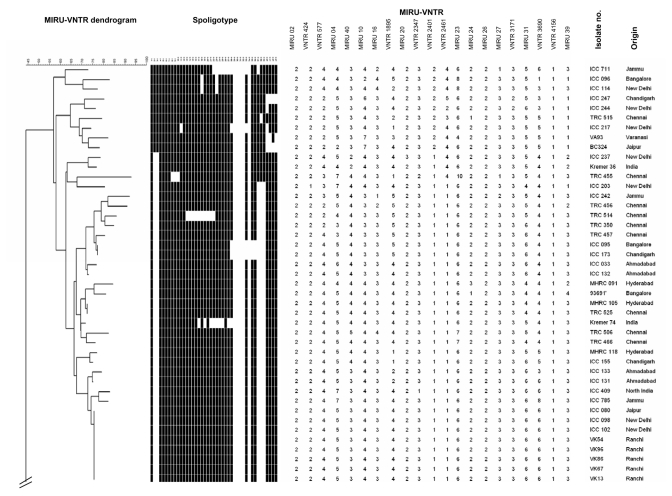
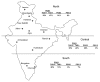
Description:Although India has the highest prevalence of tuberculosis (TB) worldwide, the genetic diversity of Mycobacterium tuberculosis in India is largely unknown. A collection of 91 isolates originating from 12 different regions spread across the country were analyzed by genotyping using 21 loci with variable-number tandem repeats (VNTRs), by spoligotyping, by principal genetic grouping (PGG), and by deletion analysis of M. tuberculosis-specific deletion region 1. The isolates showed highly diverse VNTR genotypes. Nevertheless, highly congruent groupings identified by using the 4 independent sets of markers permitted a clear definition of 3 prevalent PGG1 lineages, which corresponded to the "ancestral" East African-Indian, the Delhi, and the Beijing/W genogroups. A few isolates from PGG2 lineages and a single representative of the presumably most recent PGG3 were identified. These observations suggest a predominance of ancestral M. tuberculosis genotypes in the Indian subcontinent, which supports the hypothesis that India is an ancient endemic focus of TB.
-
Subjects:
-
Source:Emerg Infect Dis. 12(9):1367-1374.
-
Document Type:
-
Place as Subject:
-
Location:
-
Volume:12
-
Issue:9
-
Download URL:
-
File Type:
 [PDF - 211.11 KB]
 -
Collection(s):
-
Main Document Checksum:urn:sha256:a14229ada24d9e327299b1d202d08ae0a116b74818995fbca286bdb07a2ba7e7
Supporting Files


File Language:
English
 Was this page helpful?
 Found an issue?


CDC STACKS serves as an archival repository of CDC-published products including
scientific findings, journal articles, guidelines, recommendations, or other public health information authored or
co-authored by CDC or funded partners.
As a repository, CDC STACKS retains documents in their original published format to ensure public access to scientific information.
As a repository, CDC STACKS retains documents in their original published format to ensure public access to scientific information.
You May Also Like
COLLECTION
Emerging Infectious Diseases