


Advances in Clinical Trials Methodology: Intervention Optimization Approaches in Emergency Medicine
Supporting Files

-
3 2022
-
File Language:
English
Details
-
Alternative Title:Am J Emerg Med
-
Personal Author:
-
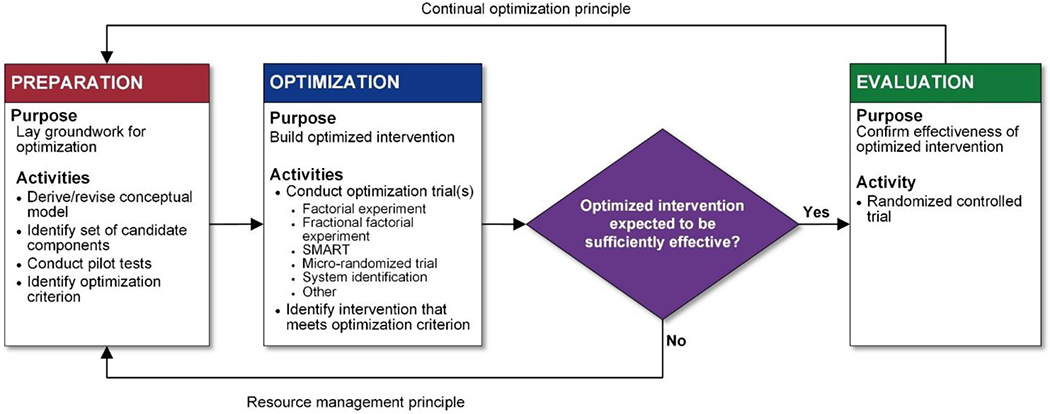
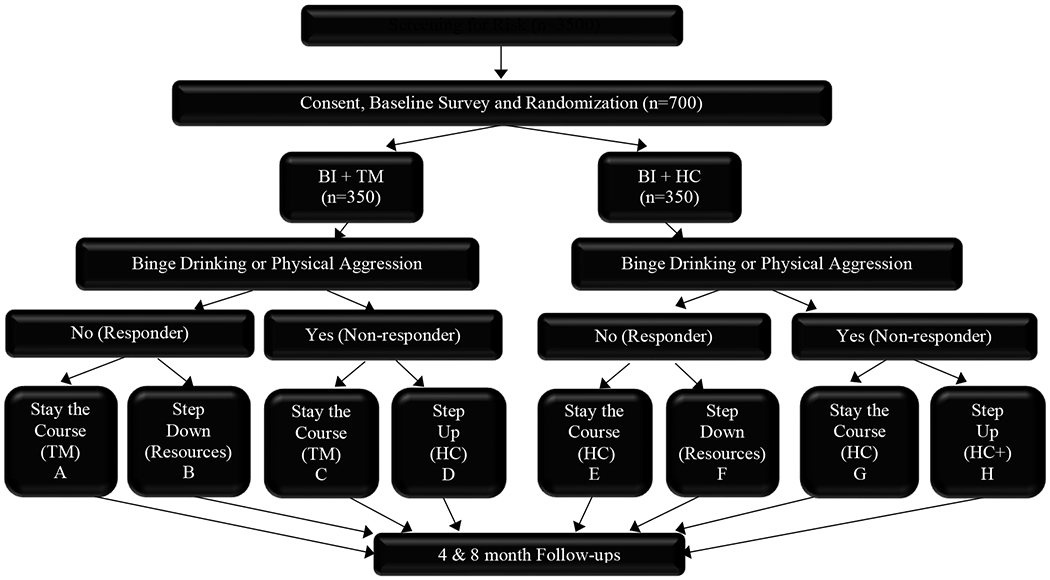
Description:The classical two-arm randomized clinical trial (RCT) is designed to test the efficacy or effectiveness of an intervention, which may consist of one or more components. However, this approach does not enable the investigator to obtain information that is important in intervention development, such as which individual components of the intervention are efficacious, which are not and possibly should be removed, and whether any components interact. The Multiphase Optimization Strategy (MOST) is a new framework for development, optimization, and evaluation of interventions. MOST includes the RCT for purposes of evaluation, but inserts a phase of research before the RCT aimed at intervention optimization. The optimization phase requires one or more separate trials similar in scope to an RCT, but employing a different experimental design. The design of the optimization trial is selected strategically so as to maximize the amount of scientific information gained using the available resources. One consideration in selecting this experimental design is the type of intervention to be optimized. If a fixed intervention, i.e. one in which the same intervention content and intensity is provided to all participants, is to be optimized, a factorial experiment is often appropriate. If an adaptive intervention, i.e. one in which intervention content or intensity is varied in a principled manner, is to be optimized, a sequential multiple-assignment randomized trial (SMART) is often a good choice. The objective of this article is to describe MOST and the scientific rationale for its use; describe two current applications of MOST in emergency medicine research, one using a factorial experiment and the other using a SMART; and discuss funding strategies and potential future applications in studying the care of individuals with acute illness, injury, or behavioral disorders.
-
Subjects:
-
Keywords:
-
Source:Am J Emerg Med. 53:6-11
-
Pubmed ID:34968972
-
Pubmed Central ID:PMC8844226
-
Document Type:
-
Funding:R01 DA040480/DA/NIDA NIH HHSUnited States/ ; R01 MD011516/MD/NIMHD NIH HHSUnited States/ ; R49CE003085/ACL/ACL HHSUnited States/ ; K23 DA039341/DA/NIDA NIH HHSUnited States/ ; R01 AA022931/AA/NIAAA NIH HHSUnited States/ ; R49 CE002099/CE/NCIPC CDC HHSUnited States/ ; P50 DA039838/DA/NIDA NIH HHSUnited States/ ; R01 AA024755/AA/NIAAA NIH HHSUnited States/ ; UL1 TR001863/TR/NCATS NIH HHSUnited States/ ; R01 CA201873/CA/NCI NIH HHSUnited States/ ; R49CE002099/ACL/ACL HHSUnited States/ ; P01 CA180945/CA/NCI NIH HHSUnited States/
-
Volume:53
-
Collection(s):
-
Main Document Checksum:urn:sha256:7a2d94c5ef683656c29e2fb3dc5d22a3f105bcad2e10160d6ba80398140427c0
-
Download URL:
-
File Type:
 [PDF
- 213.61 KB
]
[PDF
- 213.61 KB
]
Supporting Files


File Language:
English
ON THIS PAGE

CDC STACKS serves as an archival repository of CDC-published products including
scientific findings,
journal articles, guidelines, recommendations, or other public health information authored or
co-authored by CDC or funded partners.
As a repository, CDC STACKS retains documents in their original published format to ensure public access to scientific information.
As a repository, CDC STACKS retains documents in their original published format to ensure public access to scientific information.
You May Also Like
COLLECTION
CDC Public Access