



Modeling County-Level Rare Disease Prevalence Using Bayesian Hierarchical Sampling Weighted Zero-Inflated Regression✩
Supporting Files

-
2023/01/01
-
Available in CDC Stacks on May 24, 2024, 12:00 AM
File Language:
English
Details
-
Alternative Title:J Data Sci
-
Personal Author:
-
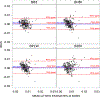
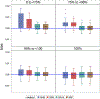
Description:Estimates of county-level disease prevalence have a variety of applications. Such estimation is often done via model-based small-area estimation using survey data. However, for conditions with low prevalence (i.e., rare diseases or newly diagnosed diseases), counties with a high fraction of zero counts in surveys are common. They are often more common than the model used would lead one to expect; such zeros are called 'excess zeros'. The excess zeros can be structural (there are no cases to find) or sampling (there are cases, but none were selected for sampling). These issues are often addressed by combining multiple years of data. However, this approach can obscure trends in annual estimates and prevent estimates from being timely. Using single-year survey data, we proposed a Bayesian weighted Binomial Zero-inflated (BBZ) model to estimate county-level rare diseases prevalence. The BBZ model accounts for excess zero counts, the sampling weights and uses a power prior. We evaluated BBZ with American Community Survey results and simulated data. We showed that BBZ yielded less bias and smaller variance than estimates based on the binomial distribution, a common approach to this problem. Since BBZ uses only a single year of survey data, BBZ produces more timely county-level incidence estimates. These timely estimates help pinpoint the special areas of county-level needs and help medical researchers and public health practitioners promptly evaluate rare diseases trends and associations with other health conditions.
-
Keywords:
-
Source:J Data Sci. 21(1):145-157
-
Pubmed ID:38799122
-
Pubmed Central ID:PMC11119276
-
Document Type:
-
Funding:
-
Genre:
-
Volume:21
-
Issue:1
-
Download URL:
-
File Type:
 [PDF - 962.71 KB]
 -
Collection(s):
-
Main Document Checksum:urn:sha-512:c9ea3c1e4d730831340abe0a523ea9805e1dd271c566b85c293b41c35aacf3ab2b8b57fe4f67ff9eeff0fbfaee39cd2e96aa0c2491c5937d376189d9b6048c7e
Supporting Files


File Language:
English
 Was this page helpful?
 Found an issue?




CDC STACKS serves as an archival repository of CDC-published products including
scientific findings, journal articles, guidelines, recommendations, or other public health information authored or
co-authored by CDC or funded partners.
As a repository, CDC STACKS retains documents in their original published format to ensure public access to scientific information.
As a repository, CDC STACKS retains documents in their original published format to ensure public access to scientific information.
You May Also Like
COLLECTION
CDC Public Access