



Effect of Regulation and Education on Reptile-associated Salmonellosis
Supporting Files
Public Domain

-
Mar 2005
File Language:
English
Details
-
Alternative Title:Emerg Infect Dis
-
Personal Author:
-
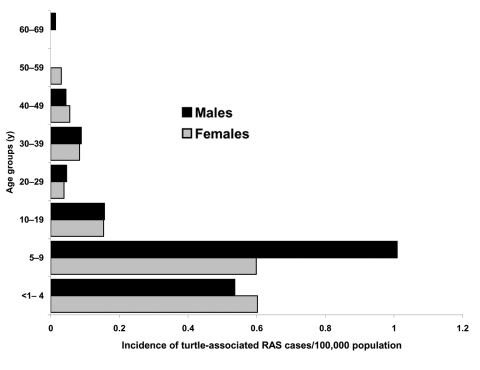
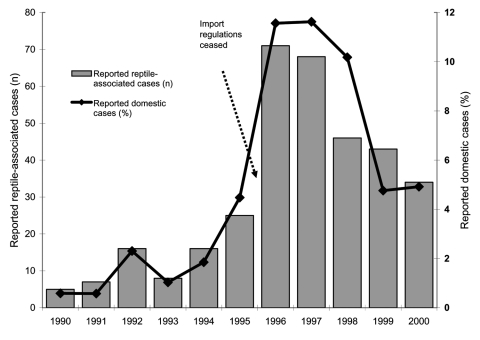
Description:Reptiles have become increasingly common as domestic pets, and with them reptile-associated Salmonella infections in humans. From 1990 to 2000, a total of 339 reptile-associated Salmonella cases were reported in Sweden. In 1996, as part of its efforts to adapt its import regulations to those of the European Union, Sweden no longer required certificates stating that imported animals were free of Salmonella. A subsequent increase was noted in the incidence of reptile-associated cases from 0.15/100,000 in the period 1990-1994 to 0.79/100,000 in 1996 and 1997. After a public education campaign was begun through the news media, the incidence dropped to 0.46/100,000. Children were the most affected age group among patients (incidence 1.3/100,000). Salmonella enterica serotype Enteritidis was the most frequent serotype (24% of isolates), followed by S. Typhimurium (9% of isolates). Import restrictions and public information campaigns are effective public health measures against reptile-associated salmonellosis.
-
Subjects:
-
Source:Emerg Infect Dis. 11(3):398-403.
-
Document Type:
-
Place as Subject:
-
Volume:11
-
Issue:3
-
Download URL:
-
File Type:
 [PDF - 230.25 KB]
 -
Collection(s):
-
Main Document Checksum:urn:sha256:7e67ae2dedcf982a4534eb72f7a20bd069b753b32dcb42b212ff16fc2c9fb6f1
Supporting Files


File Language:
English
 Was this page helpful?
 Found an issue?



CDC STACKS serves as an archival repository of CDC-published products including
scientific findings, journal articles, guidelines, recommendations, or other public health information authored or
co-authored by CDC or funded partners.
As a repository, CDC STACKS retains documents in their original published format to ensure public access to scientific information.
As a repository, CDC STACKS retains documents in their original published format to ensure public access to scientific information.
You May Also Like
COLLECTION
Emerging Infectious Diseases