



Population-based evaluation of disparities in stomach cancer by nativity among Asian and Hispanic populations in California, 2011–2015
Supporting Files

-
4 01 2024
-
Available in CDC Stacks on 2025-04-01T00:00:00Z
File Language:
English
Details
-
Alternative Title:Cancer
-
Personal Author:
-
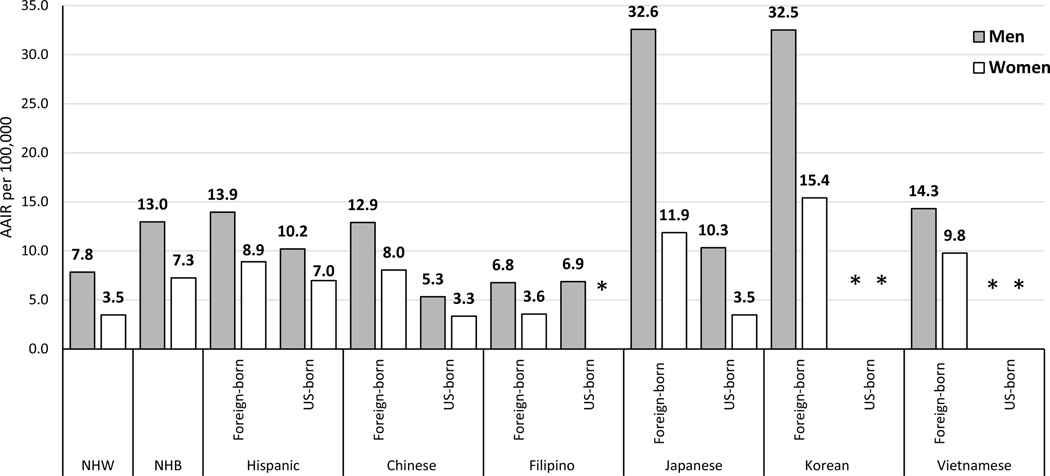
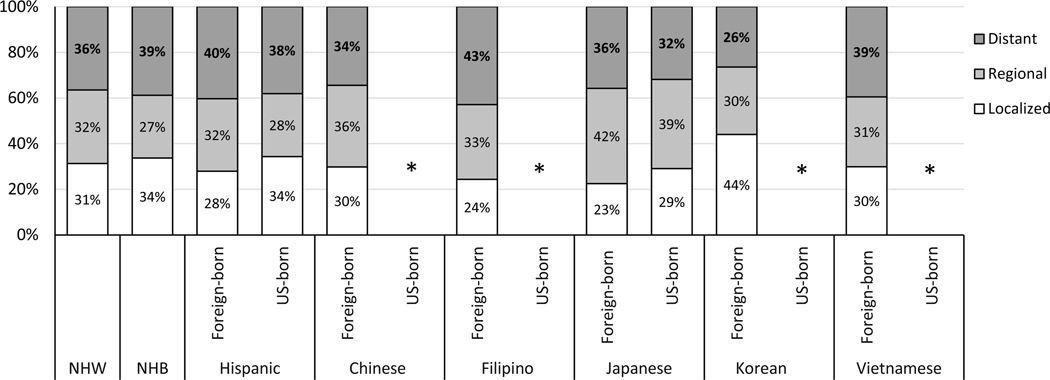
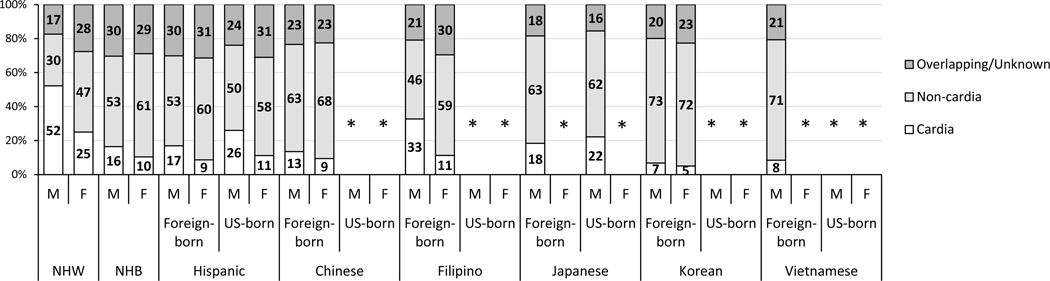
Description:Background: ; Stomach cancer incidence presents significant racial/ethnic disparities among racial/ethnic minority groups in the US, particularly among Asian and Hispanic immigrant populations. However, population-based evaluation of disparities by nativity has been scarce due to the lack of nativity-specific population denominators, especially for disaggregated Asian subgroups. We examined population-based stomach cancer incidence and tumor characteristics by detailed race/ethnicity and nativity. ; Methods: ; We calculated annual age-adjusted incidence rates (AAIRs) by race/ethnicity, sex, and nativity and evaluated tumor characteristics such as stage and anatomic subsite, using the 2011–2015 California Cancer Registry data. For Hispanic and Asian populations, we estimated nativity-specific population counts using the US Census and the American Community Survey Public Use Microdata Sample data. ; Results: ; During 2011–2015 in California, 14,198 patients were diagnosed with stomach cancer. AAIRs were higher among foreign-born individuals than their US-born counterparts. The difference was modest among Hispanics (~1.3 fold) but larger (~2 to 3-fold) among Chinese, Japanese, and Korean Americans. The highest incidence was observed for foreign-born Korean and Japanese Americans (33 and 33 per 100,000 for men; 15 and 12 per 100,000 for women, respectively). The proportion of localized stage disease was highest among foreign-born Korean Americans (44%); a similar proportion was observed among US-born Korean Americans although numbers were limited. For other Asians and Hispanics, the localized stage proportion was generally lower among foreign-born than US-born individuals, and lowest among foreign-born Japanese Americans (23%). ; Conclusions: ; Nativity-specific investigation with disaggregated racial/ethnic groups identified substantial stomach cancer disparities among foreign-born immigrant populations.
-
Subjects:
-
Keywords:
-
Source:Cancer. 130(7):1092-1100
-
Pubmed ID:38079517
-
Pubmed Central ID:PMC11018353
-
Document Type:
-
Funding:HHSN261201800032C/CA/NCI NIH HHSUnited States/ ; HHSN261201800009C/CA/NCI NIH HHSUnited States/ ; P30 CA014089/CA/NCI NIH HHSUnited States/ ; HHSN261201800032I/CA/NCI NIH HHSUnited States/ ; HHSN261201800015C/CA/NCI NIH HHSUnited States/ ; HHSN261201800009I/CA/NCI NIH HHSUnited States/ ; HHSN261201800015I/CA/NCI NIH HHSUnited States/ ; 1NU58DP007156/CC/CDC HHSUnited States/
-
Place as Subject:
-
Volume:130
-
Issue:7
-
Download URL:
-
File Type:
 [PDF - 751.06 KB]
 -
Collection(s):
-
Main Document Checksum:urn:sha-512:81abdf4141caa2a19f6f51f7b829efd483b2cd818f16ed715327f0c1369a8551dbe978fdb660d3490b42b6819f7a5502842a1b2b9531b15064eba7097fa0cee6
Supporting Files


File Language:
English
 Was this page helpful?
 Found an issue?



CDC STACKS serves as an archival repository of CDC-published products including
scientific findings, journal articles, guidelines, recommendations, or other public health information authored or
co-authored by CDC or funded partners.
As a repository, CDC STACKS retains documents in their original published format to ensure public access to scientific information.
As a repository, CDC STACKS retains documents in their original published format to ensure public access to scientific information.
You May Also Like
COLLECTION
CDC Public Access