



Temporal Trends in Hepatitis C–Related Hospitalizations, United States, 2000–2019
Supporting Files

-
12 15 2023 ; 12-15-
-
Available in CDC Stacks on December 15, 2024, 12:00 AM

File Language:
English
Details
-
Alternative Title:Clin Infect Dis
-
Personal Author:
-
Description:Background.
Hospitalization burden related to hepatitis C virus (HCV) infection is substantial. We sought to describe temporal trends in hospitalization rates before and after release of direct-acting antiviral (DAA) agents.
Methods.
We analyzed 2000–2019 data from adults aged ≥18 years in the National Inpatient Sample. Hospitalizations were HCV-related if (1) hepatitis C was the primary diagnosis, or (2) hepatitis C was any secondary diagnosis with a liver-related primary diagnosis. We analyzed characteristics of HCV-related hospitalizations nationally and examined trends in age-adjusted hospitalization rates.
Results.
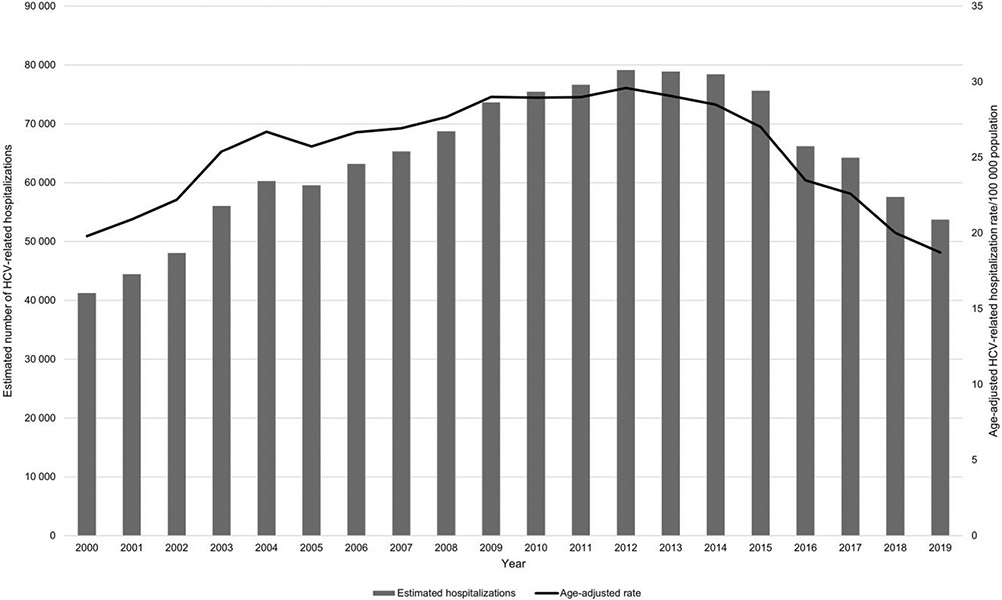
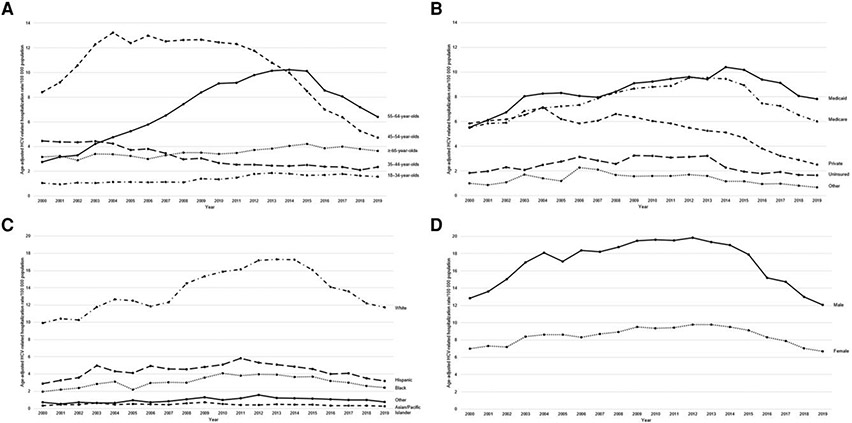
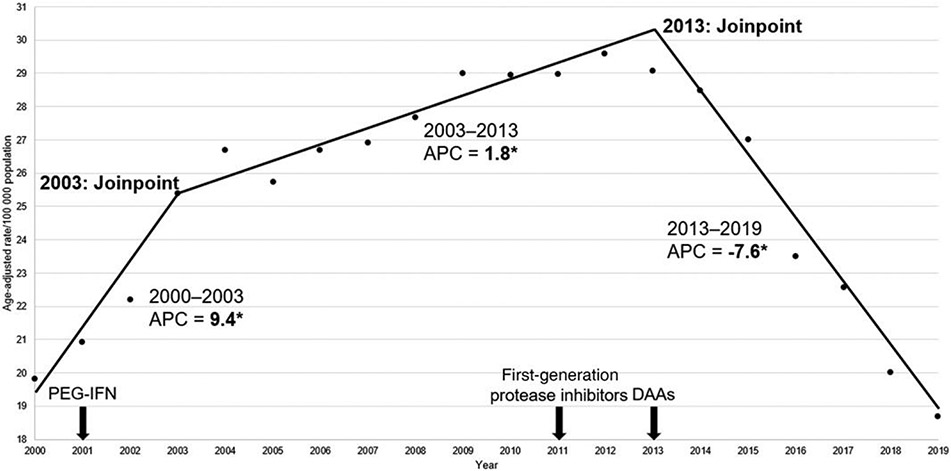
During 2000–2019, there were an estimated 1 286 397 HCV-related hospitalizations in the United States. The annual age-adjusted hospitalization rate was lowest in 2019 (18.7/100 000 population) and highest in 2012 (29.6/100 000 population). Most hospitalizations occurred among persons aged 45–64 years (71.8%), males (67.1%), White non-Hispanic persons (60.5%), and Medicaid/Medicare recipients (64.0%). The national age-adjusted hospitalization rate increased during 2000–2003 (annual percentage change APC, 9.4%; P < .001) and 2003–2013 (APC, 1.8%; P < .001) before decreasing during 2013–2019 (APC, −7.6%; P < .001). Comparing 2000 to 2019, the largest increases in hospitalization rates occurred among persons aged 55–64 years (132.9%), Medicaid recipients (41.6%), and Black non-Hispanic persons (22.3%).
Conclusions.
Although multiple factors likely contributed, overall HCV-related hospitalization rates declined steadily after 2013, coinciding with the release of DAAs. However, the declines were not observed equally among age, race/ethnicity, or insurance categories. Expanded access to DAA treatment is needed, particularly among Medicaid and Medicare recipients, to reduce disparities and morbidity and eliminate hepatitis C as a public health threat. -
Subjects:
-
Keywords:
-
Source:Clin Infect Dis. 77(12):1668-1675
-
Pubmed ID:37463305
-
Pubmed Central ID:PMC11017377
-
Document Type:
-
Funding:
-
Volume:77
-
Issue:12
-
Download URL:
-
File Type:
 [PDF - 723.44 KB]
 -
Collection(s):
-
Main Document Checksum:urn:sha-512:b4686571bfadba7a900336b087ce35e0c4ef58fd713d1dab563bea289fff4c84e873522ae040adbede17a5910cebbcc89a57eedde27c4c165f26f1ab467a2e14
Supporting Files


File Language:
English
 Was this page helpful?
 Found an issue?



CDC STACKS serves as an archival repository of CDC-published products including
scientific findings, journal articles, guidelines, recommendations, or other public health information authored or
co-authored by CDC or funded partners.
As a repository, CDC STACKS retains documents in their original published format to ensure public access to scientific information.
As a repository, CDC STACKS retains documents in their original published format to ensure public access to scientific information.
You May Also Like
COLLECTION
CDC Public Access