


A Comprehensive Approach to Assuring Quality of Laboratory Testing in HIV Surveys: Lessons Learned from the Population-based HIV Impact Assessment Project
Supporting Files

-
8 01 2021
-
File Language:
English
Details
-
Alternative Title:J Acquir Immune Defic Syndr
-
Personal Author:Patel, Hetal K. ; Duong, Yen T. ; Birhanu, Sehin ; Dobbs, Trudy ; Lupoli, Kathryn ; Moore, Carole ; Detorio, Mervi ; Sleeman, Katrina ; Manjengwa, Julius ; Wray-Gordon, Floris ; Yavo, Daniel ; Jackson, Keisha ; Domaoal, Robert A. ; Yufenyuy, Ernest ; Vedapuri, Shanmugam ; Ndongmo, Clement ; Ogollah, Francis ; Dzinamarira, Tafadzwa ; Rubinstein, Paul ; Sachathep, Karampreet K ; Metz, Melissa ; Longwe, Herbert ; Suzue, Saito ; Voetsch, Andrew C. ; Parekh, Bharat
-
Description:Background:
Conducting HIV surveys in resource-limited settings is challenging due to logistics, limited availability of trained personnel, and complexity of testing. We describe procedures and systems deemed critical to ensure high-quality laboratory data in the Population-Based HIV Impact Assessments (PHIA), large-scale household (HH) surveys.
Methods:
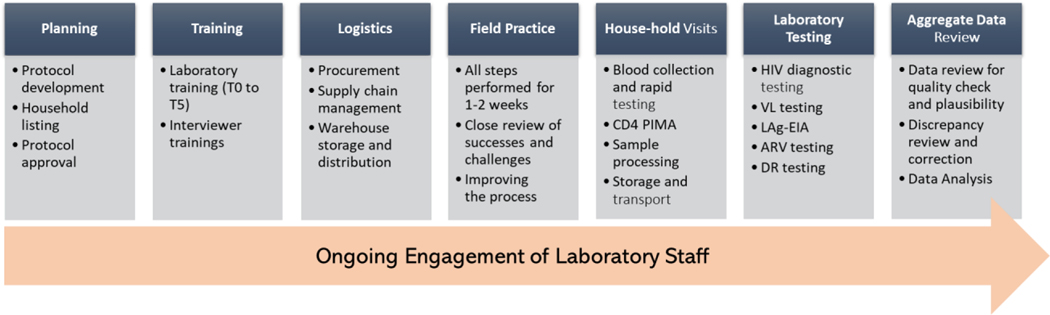
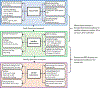
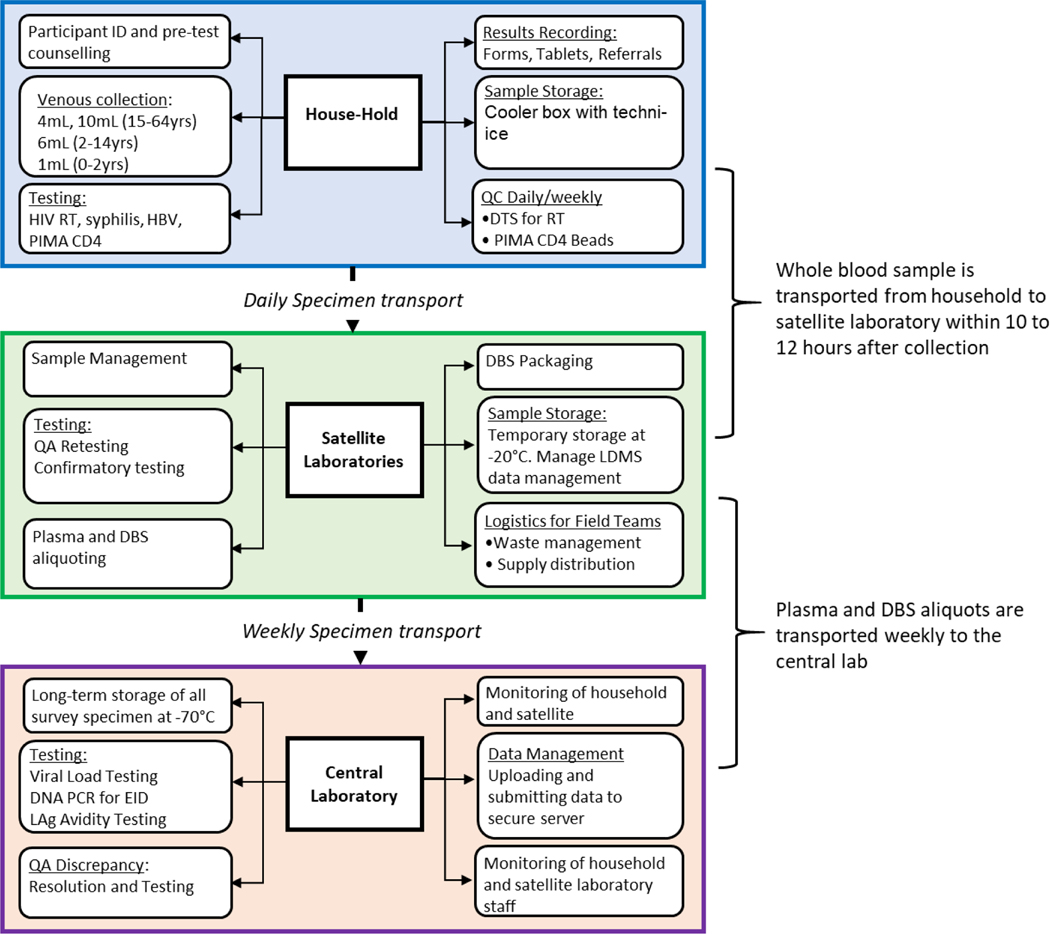
Laboratory professionals were engaged in every stage of the surveys, including protocol development, site assessments, procurement, training, quality assurance, monitoring, analysis, and reporting writing. A tiered network of HH, satellite, and central laboratories, accompanied with trainings, optimized process for blood collection, storage, transport, and real-time monitoring of specimen quality and test results at each level proved critical in maintaining specimen integrity and high-quality testing. A plausibility review of aggregate merged data was conducted to confirm associations between key variables as final quality check for quality of laboratory results.
Results:
Overall, we conducted hands-on training of 3,355 survey staff across 13 surveys with 160 to 387 personnel trained per survey on biomarker processes. Extensive training and monitoring demonstrated that overall, 99% of specimens had adequate volume and 99.8% had no hemolysis indicating high-quality. We implemented quality control and proficiency testing for testing, resolved discrepancies, verified >300 PIMA instruments and monitored user errors. Aggregate data review for plausibility further confirmed high quality of testing.
Conclusion:
Ongoing engagement of laboratory personnel to oversee processes at all levels of the survey is critical for successful national surveys. High quality PHIA laboratory data ensured reliable results and demonstrated impact of HIV programs in 13 countries.
-
Subjects:
-
Keywords:
-
Source:J Acquir Immune Defic Syndr. 87(Suppl 1):S17-S27
-
Pubmed ID:34166309
-
Pubmed Central ID:PMC10966620
-
Document Type:
-
Funding:
-
Volume:87
-
Collection(s):
-
Main Document Checksum:urn:sha256:f245005cea1685baafc63cae1e3dab70b0ce04fa4469b5848ed42eb9d57dbcf1
-
Download URL:
-
File Type:
 [PDF
- 1.32 MB
]
[PDF
- 1.32 MB
]
Supporting Files


File Language:
English
ON THIS PAGE



CDC STACKS serves as an archival repository of CDC-published products including
scientific findings,
journal articles, guidelines, recommendations, or other public health information authored or
co-authored by CDC or funded partners.
As a repository, CDC STACKS retains documents in their original published format to ensure public access to scientific information.
As a repository, CDC STACKS retains documents in their original published format to ensure public access to scientific information.
You May Also Like
COLLECTION
CDC Public Access