



Isolation of Diverse Simian Arteriviruses Causing Hemorrhagic Disease
Supporting Files

-
4 2024
File Language:
English
Details
-
Alternative Title:Emerg Infect Dis
-
Personal Author:Shaw, Teressa M. ; Dettle, Samuel T. ; Mejia, Andres ; Hayes, Jennifer M. ; Simmons, Heather A. ; Basu, Puja ; Kuhn, Jens H. ; Ramuta, Mitchell D. ; Warren, Cody J. ; Jahrling, Peter B. ; O’Connor, David H. ; Huang, Liupei ; Zaeem, Misbah ; Seo, Jiwon ; Slukvin, Igor I. ; Brown, Matthew E. ; Bailey, Adam L.
-
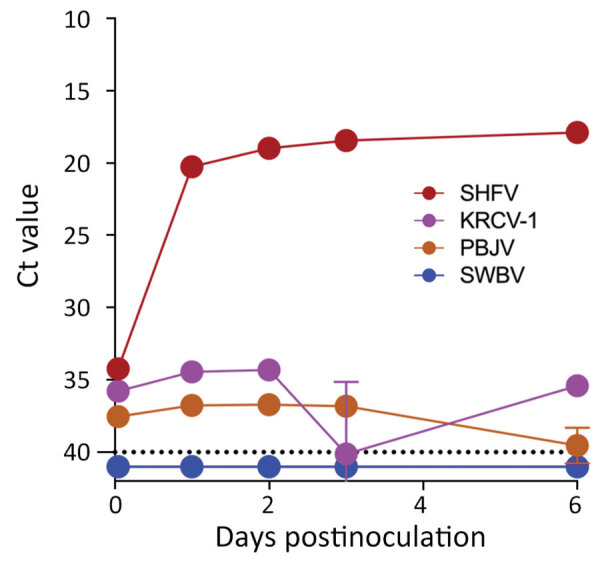
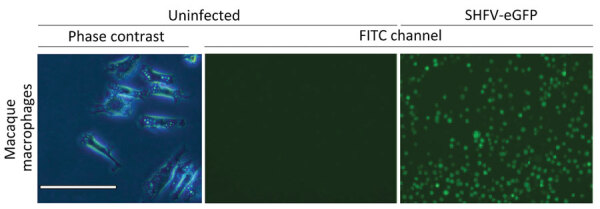
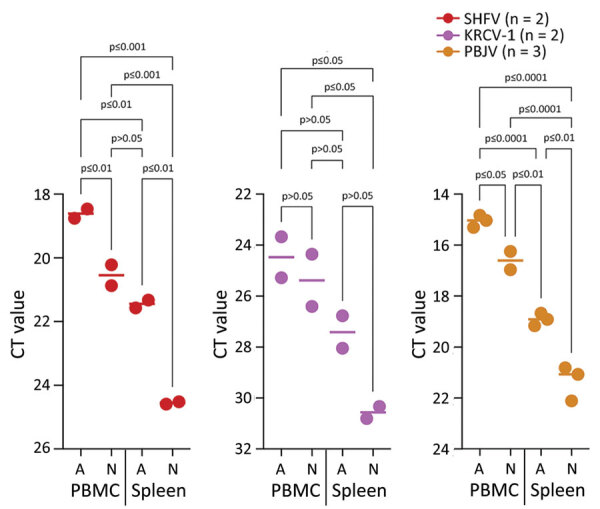
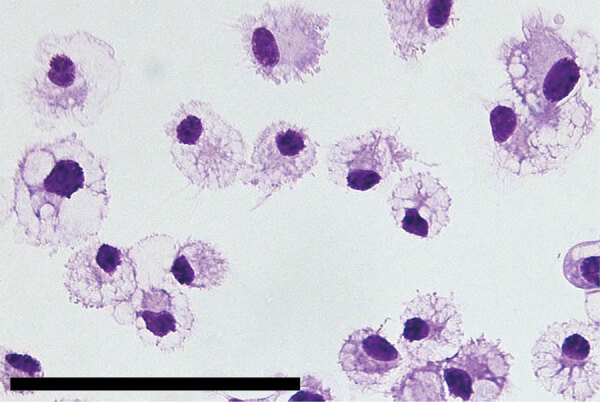
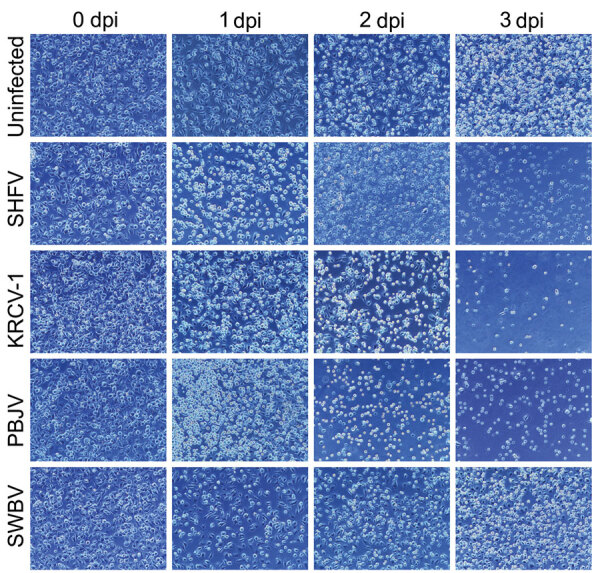
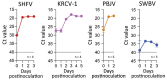
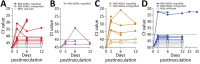
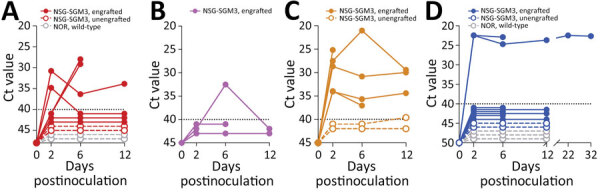
Description:Genetically diverse simian arteriviruses (simarteriviruses) naturally infect geographically and phylogenetically diverse monkeys, and cross-species transmission and emergence are of considerable concern. Characterization of most simarteriviruses beyond sequence analysis has not been possible because the viruses fail to propagate in the laboratory. We attempted to isolate 4 simarteriviruses, Kibale red colobus virus 1, Pebjah virus, simian hemorrhagic fever virus, and Southwest baboon virus 1, by inoculating an immortalized grivet cell line (known to replicate simian hemorrhagic fever virus), primary macaque cells, macrophages derived from macaque induced pluripotent stem cells, and mice engrafted with macaque CD34+-enriched hematopoietic stem cells. The combined effort resulted in successful virus isolation; however, no single approach was successful for all 4 simarteriviruses. We describe several approaches that might be used to isolate additional simarteriviruses for phenotypic characterization. Our results will expedite laboratory studies of simarteriviruses to elucidate virus-host interactions, assess zoonotic risk, and develop medical countermeasures.
-
Subjects:
-
Keywords:
- arterivirid
- Arteriviridae
- arterivirus
- engraft
- induced pluripotent stem cell
- iPSC
- Kibale red colobus virus
- KRCV-1
- NHP
- nonhuman primate
- PBJV
- Pebjah virus
- SHFV
- simarterivirin
- Simarterivirinae
- simarterivirus
- simian hemorrhagic fever virus
- southwest baboon virus
- SWBV
- viruses
- zoonoses
- United States
- Melioidosis
- Burkholderia pseudomallei
- bacteria
- history
-
Source:Emerg Infect Dis. 2024; 30(4):721-731
-
Pubmed ID:38526136
-
Pubmed Central ID:PMC10977827
-
Document Type:
-
Funding:P30 CA014520/CA/NCI NIH HHSUnited States/ ; R00 AI151256/AI/NIAID NIH HHSUnited States/ ; HHSN272201800013C/AI/NIAID NIH HHSUnited States/ ; P51 OD011106/OD/NIH HHSUnited States/ ; 75N93021C00004/AI/NIAID NIH HHSUnited States/ ; C06 RR020141/RR/NCRR NIH HHSUnited States/ ; C06 RR015459/RR/NCRR NIH HHSUnited States/ ; U01 HL134764/HL/NHLBI NIH HHSUnited States/ ; R01 HD103443/HD/NICHD NIH HHSUnited States/
-
Volume:30
-
Issue:4
-
Download URL:
-
File Type:
 [PDF - 4.71 MB]
 -
Collection(s):
-
Main Document Checksum:urn:sha256:e0d0fea8498333cea49f8e17c8a14e5e6d4f206b5e89285077b5cfe41aa16eef
Supporting Files


File Language:
English
 Was this page helpful?
 Found an issue?


CDC STACKS serves as an archival repository of CDC-published products including
scientific findings, journal articles, guidelines, recommendations, or other public health information authored or
co-authored by CDC or funded partners.
As a repository, CDC STACKS retains documents in their original published format to ensure public access to scientific information.
As a repository, CDC STACKS retains documents in their original published format to ensure public access to scientific information.
You May Also Like
COLLECTION
Emerging Infectious Diseases