


Medicaid Expansion and Contraceptive Use Among Female High-School Students
Supporting Files

-
10 2022
-
File Language:
English
Details
-
Alternative Title:Am J Prev Med
-
Personal Author:
-
Description:Introduction:
Access to effective contraception prevents unintended pregnancies among sexually active female youth. Potentially impacted by the Affordable Care Act’s Medicaid-related policies, contraception use increased among sexually active high-school students from 2013 to 2019.
Methods:
Analyses conducted in 2021 assessed state-level Youth Risk Behavior Survey data among female students in grades 9–12 who reported being sexually active. States that expanded Medicaid were compared with other states in 2013 (baseline) and 2019 (after expansion). Measured outcomes included self-reported use of moderately effective or highly effective, long-acting reversible contraception at last sex. Long-acting reversible contraception included intrauterine devices and implants. Moderately effective contraception included birth control pills, injectables, patches, or rings. Results were weighted and adjusted for age and race/ethnicity.
Results:
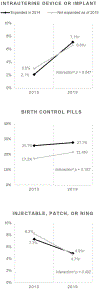
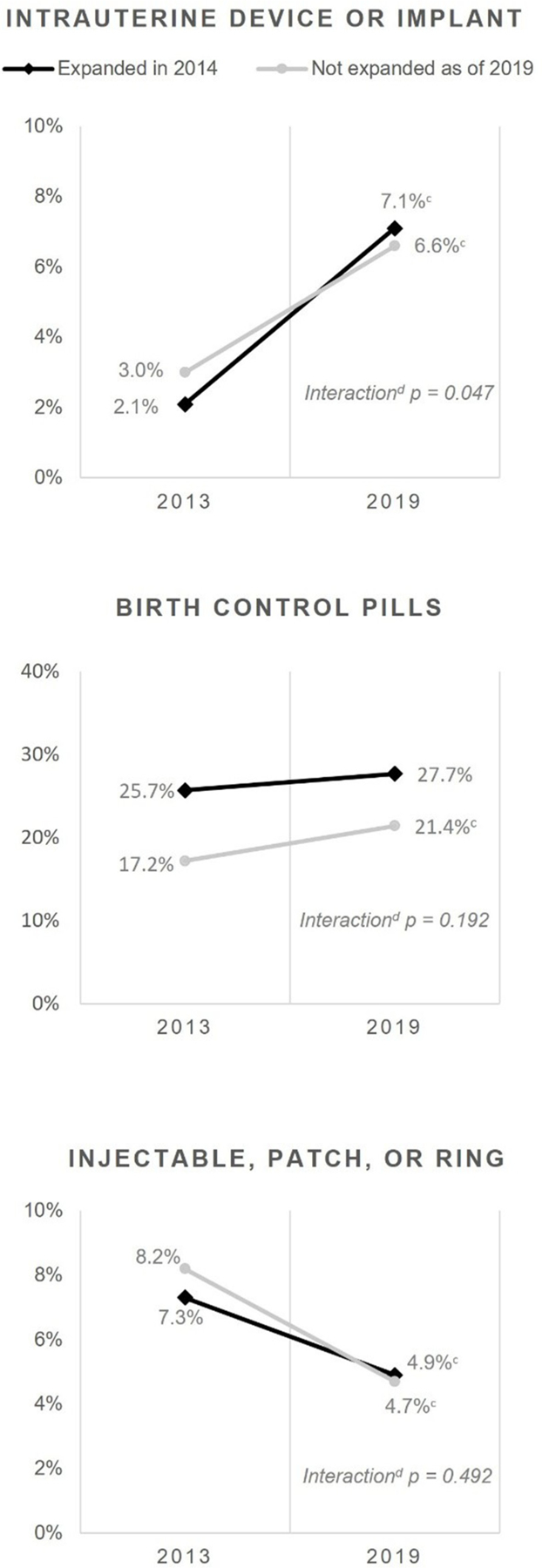
Students in Medicaid expansion states (n=27,564) did not differ significantly from those in nonexpansion states (n=6,048) at baseline or after expansion with respect to age, age at first sex, or the number of sexual partners in the past 3 months; however, race/ethnicity population characteristics changed over time. Postexpansion increased use of intrauterine devices/implants was greater in Medicaid expansion states than in nonexpansion states (238.1% increase vs 120.0% increase, adjusted p=0.047). For those aged 16–17 years, Medicaid expansion states had a 283.3% increase in intrauterine device/implant use compared with an increase of 69.7% in nonexpansion states (adjusted p=0.004).
Conclusions:
Medicaid expansion was associated with a greater population-level increase in intrauterine device/implant use among sexually active female high-school students aged 16–17 years. These findings point to the possibility that the Affordable Care Act’s Medicaid-related policies played a role in young women’s use of intrauterine devices/implants.
-
Subjects:
-
Source:Am J Prev Med. 63(4):592-602
-
Pubmed ID:35688721
-
Pubmed Central ID:PMC10926112
-
Document Type:
-
Funding:
-
Volume:63
-
Issue:4
-
Collection(s):
-
Main Document Checksum:urn:sha256:e6b40e43bf5c440e5e1da542b5969f5b011d816a90e7b46869e7baddafb142c5
-
Download URL:
-
File Type:
 [PDF
- 218.15 KB
]
[PDF
- 218.15 KB
]
Supporting Files


File Language:
English
ON THIS PAGE

CDC STACKS serves as an archival repository of CDC-published products including
scientific findings,
journal articles, guidelines, recommendations, or other public health information authored or
co-authored by CDC or funded partners.
As a repository, CDC STACKS retains documents in their original published format to ensure public access to scientific information.
As a repository, CDC STACKS retains documents in their original published format to ensure public access to scientific information.
You May Also Like
COLLECTION
CDC Public Access