



Mosaic chromosomal alterations detected in men living with HIV and the relationship to non-Hodgkin lymphoma
Supporting Files

-
7 01 2023 ; 7-01-
-
Available in CDC Stacks on July 01, 2024, 12:00 AM
File Language:
English
Details
-
Alternative Title:AIDS
-
Personal Author:
-
Description:Objectives:
People living with HIV (PLWH) have elevated risk of non-Hodgkin lymphoma (NHL) and other diseases. Studying clonal hematopoiesis (CH), the clonal expansion of mutated hematopoietic stem cells, could provide insights regarding elevated NHL risk.
Design:
Cohort analysis of participants in the Multicenter AIDS Cohort Study (N=5,979).
Methods:
Mosaic chromosomal alterations (mCAs), a type of CH, were detected from genotyping array data using MoChA. We compared CH prevalence in men living with HIV (MLWH) to HIV-uninfected men using logistic regression, and among MLWH, assessed the associations of CH with NHL incidence and overall mortality using Poisson regression.
Results:
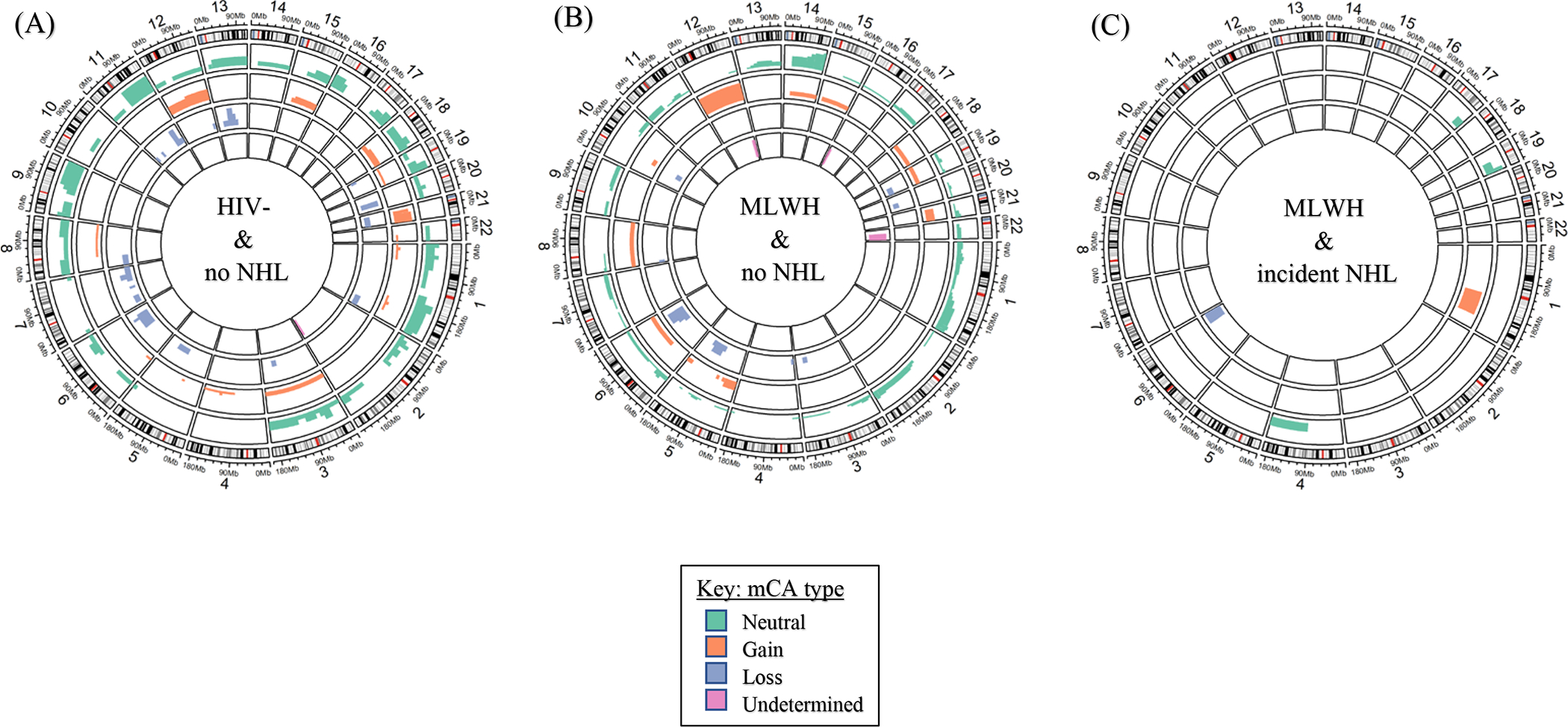
Comparing MLWH to HIV-uninfected men, we observed no difference in the frequency of autosomal mCAs (3.9% vs. 3.6%, p-value=0.09) or mosaic loss of the Y chromosome (mLOY) (1.4% vs. 2.9%, p-value=0.13). Autosomal mCAs involving copy-neutral loss of heterozygosity (CN-LOH) of chromosome 14q were more common in MLWH. Among MLWH, mCAs were not associated with subsequent NHL incidence (autosomal mCA p-value=0.65, mLOY p-value=0.48). However, two MLWH with diffuse large B-cell lymphoma had overlapping CN-LOH mCAs on chromosome 19 spanning U2AF2 (involved in RNA splicing), and one MLWH with Burkitt lymphoma had high-frequency mCAs involving chromosome 1 gain and chromosome 17 CN-LOH (cell fractions 22.1% and 25.0%, respectively). mCAs were not associated with mortality among MLWH (autosomal mCA p-value=0.52, mLOY p-value=0.93).
Conclusions:
We found limited evidence for a relationship between HIV infection and mCAs. Although mCAs were not significantly associated with NHL, mCAs detected in several NHL cases indicate a need for further investigation. -
Subjects:
-
Keywords:
-
Source:AIDS. 37(8):1307-1313
-
Pubmed ID:36927626
-
Pubmed Central ID:PMC10500031
-
Document Type:
-
Funding:U01 AI035042/AI/NIAID NIH HHSUnited States/ ; HHSN261201000140C/CA/NCI NIH HHSUnited States/ ; HHSN261201000035C/CA/NCI NIH HHSUnited States/ ; UL1 TR001079/TR/NCATS NIH HHSUnited States/ ; U01 AI035041/AI/NIAID NIH HHSUnited States/ ; UM1 AI035043/AI/NIAID NIH HHSUnited States/ ; U58 DP000795/DP/NCCDPHP CDC HHSUnited States/ ; Z99 CA999999/ImNIH/Intramural NIH HHSUnited States/ ; U01 HL146201/HL/NHLBI NIH HHSUnited States/ ; HHSN261201000035I/CA/NCI NIH HHSUnited States/ ; HHSN261201000034C/CA/NCI NIH HHSUnited States/ ; U58 DP003862/DP/NCCDPHP CDC HHSUnited States/ ; U01 AI035040/AI/NIAID NIH HHSUnited States/ ; U01 HL146240/HL/NHLBI NIH HHSUnited States/ ; U01 AI035039/AI/NIAID NIH HHSUnited States/
-
Volume:37
-
Issue:8
-
Download URL:
-
File Type:
 [PDF - 659.42 KB]
 -
Collection(s):
-
Main Document Checksum:urn:sha-512:b981c5b25d408bfc9ffc51d22b25216bb51128b13382afae8e804132471b91710374db49522f20312b623ffa54036f47b8d9b054344a92916037449003f08ac3


File Language:
English
 Was this page helpful?
 Found an issue?

CDC STACKS serves as an archival repository of CDC-published products including
scientific findings, journal articles, guidelines, recommendations, or other public health information authored or
co-authored by CDC or funded partners.
As a repository, CDC STACKS retains documents in their original published format to ensure public access to scientific information.
As a repository, CDC STACKS retains documents in their original published format to ensure public access to scientific information.
You May Also Like
COLLECTION
CDC Public Access