



Mortality among solid organ transplant recipients with a pretransplant cancer diagnosis
Supporting Files

-
2 2023 ; 2-2023
-
Available in CDC Stacks on 2024-02-01T00:00:00Z

File Language:
English
Details
-
Alternative Title:Am J Transplant
-
Personal Author:
-
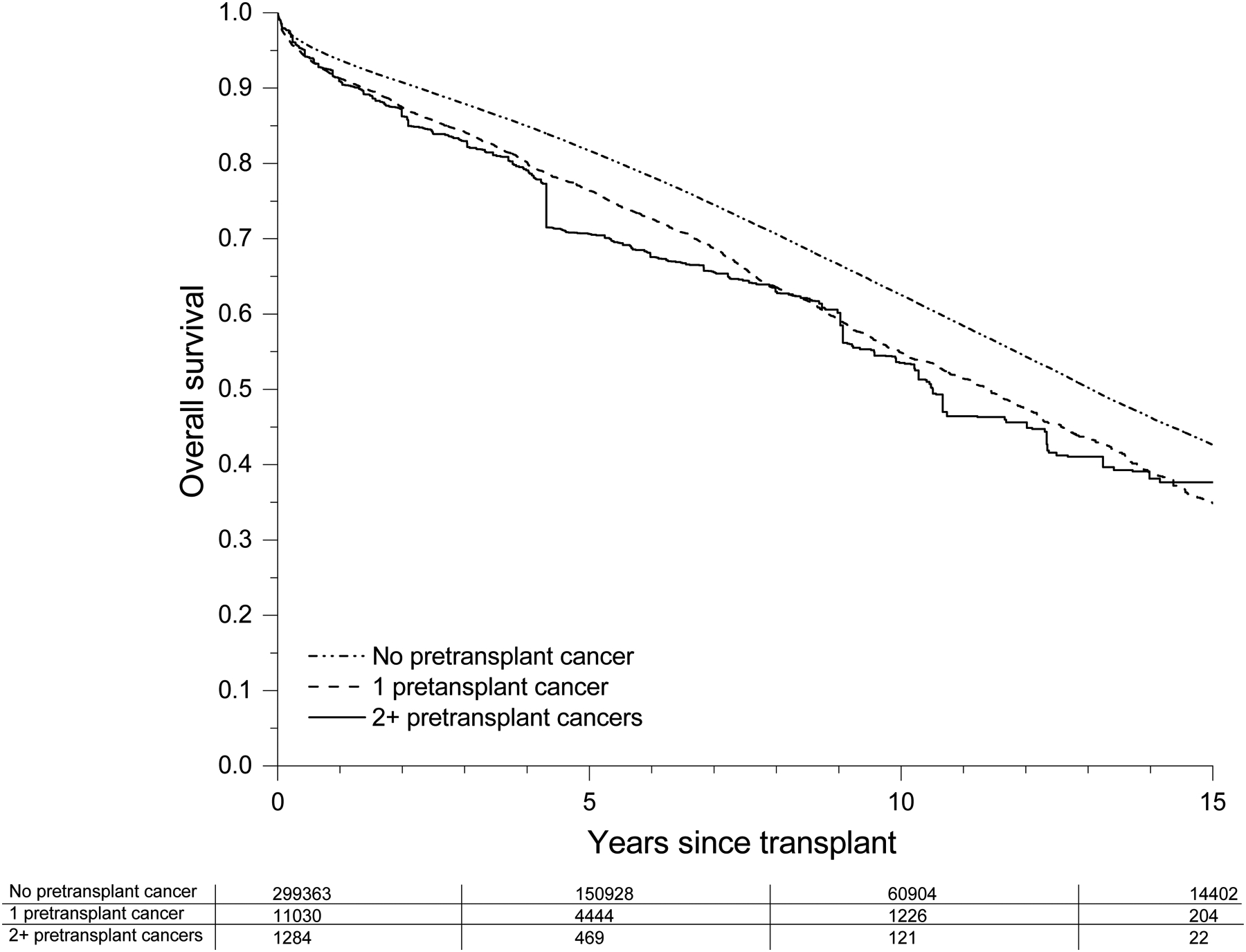
Description:Little is known about the outcomes among solid organ transplant recipients with a pretransplant cancer diagnosis. We used linked data from the Scientific Registry of Transplant Recipients with 33 US cancer registries. Cox proportional hazards models assessed associations of pretransplant cancer with overall mortality, cancer-specific mortality, and development of a new posttransplant cancer. Among 311 677 recipients, the presence of a single pretransplant cancer was associated with increased overall mortality (adjusted hazard ratio aHR, 1.19; 95% CI, 1.15-1.23) and cancer-specific mortality (aHR, 1.93; 95% CI, 1.76-2.12); results for 2+ pretransplant cancers were similar. Cancer-specific mortality was not significantly increased for uterine, prostate, or thyroid cancers (aHRs were 0.83, 1.22, and 1.54, respectively) but strongly elevated for lung cancer and myeloma (aHRs were 3.72 and 4.42, respectively). A pretransplant cancer diagnosis was also associated with increased risk of developing posttransplant cancer (aHR, 1.32; 95% CI, 1.23-1.40). Among 306 recipients whose cancer death was confirmed by cancer registry data, 158 deaths (51.6%) were from a de novo posttransplant cancer and 105 (34.3%) from the pretransplant cancer. Pretransplant cancer diagnoses are associated with increased mortality after transplantation, but some deaths are related to posttransplant cancers and other causes. Improved candidate selection and cancer screening and prevention may reduce mortality in this population.
-
Subjects:
-
Source:Am J Transplant. 23(2):257-264
-
Pubmed ID:36804133
-
Pubmed Central ID:PMC9978936
-
Document Type:
-
Funding:75N99021D00009/OF/ORFDO NIH HHSUnited States/ ; HHSN261201000037C/CA/NCI NIH HHSUnited States/ ; N01PC35143/CA/NCI NIH HHSUnited States/ ; NU58DP006320/CC/CDC HHSUnited States/ ; U58 DP003875/DP/NCCDPHP CDC HHSUnited States/ ; HHSN261201800013C/CA/NCI NIH HHSUnited States/ ; 75N96021D00006/ES/NIEHS NIH HHSUnited States/ ; 75N96021D00009/ES/NIEHS NIH HHSUnited States/ ; 75N98021D00006/NH/NIH HHSUnited States/ ; U58 DP000807/DP/NCCDPHP CDC HHSUnited States/ ; HHSN261201800020C/CA/NCI NIH HHSUnited States/ ; HHSN261201000035I/CA/NCI NIH HHSUnited States/ ; U58 DP000848/DP/NCCDPHP CDC HHSUnited States/ ; ZIA CP010150/ImNIH/Intramural NIH HHSUnited States/ ; 27305C0011/ES/NIEHS NIH HHSUnited States/ ; HHSN261201800004C/CA/NCI NIH HHSUnited States/ ; U58 DP003883/DP/NCCDPHP CDC HHSUnited States/ ; HHSN261201000035C/CA/NCI NIH HHSUnited States/ ; P30 CA086862/CA/NCI NIH HHSUnited States/ ; HHSN261201000036C/CA/NCI NIH HHSUnited States/ ; N01PC35137/CA/NCI NIH HHSUnited States/ ; HHSN261201800014C/CA/NCI NIH HHSUnited States/ ; HHSN261201800016C/CA/NCI NIH HHSUnited States/ ; HHSN261201800016I/CA/NCI NIH HHSUnited States/ ; 27307C0011/ES/NIEHS NIH HHSUnited States/ ; U58 DP003933/DP/NCCDPHP CDC HHSUnited States/ ; HHSN261201000034C/CA/NCI NIH HHSUnited States/ ; U58 DP003921/DP/NCCDPHP CDC HHSUnited States/ ; 75N92021D00006/HL/NHLBI NIH HHSUnited States/ ; 27398C0011/ES/NIEHS NIH HHSUnited States/ ; HHSN261201800014I/CA/NCI NIH HHSUnited States/ ; N01PC35139/CA/NCI NIH HHSUnited States/ ; HHSN261201800002C/CA/NCI NIH HHSUnited States/ ; HHSN261201800013I/CA/NCI NIH HHSUnited States/ ; HHSN261201800006I/CA/NCI NIH HHSUnited States/ ; U58 DP000824/DP/NCCDPHP CDC HHSUnited States/ ; HHSN261201800002B/CA/NCI NIH HHSUnited States/ ; 75N97021D00006/LM/NLM NIH HHSUnited States/ ; 75N92021D00009/HL/NHLBI NIH HHSUnited States/ ; 75N90021D00009/HL/NHLBI NIH HHSUnited States/
-
Volume:23
-
Issue:2
-
Download URL:
-
File Type:
 [PDF - 192.26 KB]
 -
Collection(s):
-
Main Document Checksum:urn:sha-512:afa59979feb212840bc3d94b61212f3c973c244aaa6df31742a3eb6f662854715ad41b3444c0c7c8ffd1ba9b58d45cc56732847ffb56d6f088e3bfc4459ee124
Supporting Files


File Language:
English
 Was this page helpful?
 Found an issue?


CDC STACKS serves as an archival repository of CDC-published products including
scientific findings, journal articles, guidelines, recommendations, or other public health information authored or
co-authored by CDC or funded partners.
As a repository, CDC STACKS retains documents in their original published format to ensure public access to scientific information.
As a repository, CDC STACKS retains documents in their original published format to ensure public access to scientific information.
You May Also Like
COLLECTION
CDC Public Access